FDA Guidance on Peptides? What the Agency Has Actually Published
The question, as typed
Autocomplete carries this one on a second engine. Bing's own suggestion API, queried live on 2026-09-11 against "fda warning letter peptides," returns "fda guidance on peptides," "fda regulations on peptides," and "fda guideline certain peptides," the same demand Google Suggest independently surfaces as "is bpc 157 fda approved" and "is bpc 157 legal." Two engines, the same buyer, looking for one document that would settle it in a single read.
That document does not exist, and searching for it wastes the afternoon it was supposed to save. What exists instead is a set of overlapping rules that answer different questions: what a drug company must prove before selling a pill, what a compounding pharmacy may prepare for one patient, and what a supplement seller must not claim. None of the three is called "peptide guidance," and none of them was written with this buyer's question in mind.
What the wrong assumption costs
Two failure modes recur, and both are documented in the regulator's own pages:
| What happens | The documented cost |
|---|---|
| Trusting "sold openly" as "FDA guidance approved" | FDA's own words: unapproved drugs "have not been reviewed by FDA for safety, effectiveness or quality" |
| Reading a compounding docket as a pending approval | The Federal Register API returns exactly one BPC-157 document, a notice opening a public docket, a nomination under review |
| Buying under a "research use only" label instead of checking the lane | The FDA "does not approve dietary supplements," and a company "can often introduce a dietary supplement to the market without notifying the FDA" |
Quotes as served on the linked pages. FDA Unapproved Drugs page dated 2026-05-14; FDA 101 page dated 2025-03-03; Federal Register notice dated 2026-04-16.
What people pay instead of settling this question: peptide guides were listed at $9.99 to $87.90 across the stores checked on 2026-09-13, most citing zero regulator text on the page itself. None of them quotes the FDA's own three-lane framework with dates. The map does, verbatim.
What you hold at the end
- The three-lane framework, settled: which FDA rule actually applies to a supplement, a compounded article, and an approved drug, quoted verbatim with dates and links you can open.
- The BPC-157 row: the exact Federal Register document, its date, and what "nomination under review" means for a buyer today.
- The compounded-GLP-1 row, quoted the same way, for the peptide class most likely to reach a prescription pad.
- A one-line resolution to "is there an FDA guidance on peptides," so the next forum thread does not reopen it.
This is part of the peptide card, file 09 of the map; read it before peptide curiosity becomes a purchase.
The three FDA lanes, in order
TL;DR
- No FDA document is titled "peptide guidance." Peptides are sorted by lane, not by name.
- Lane 1, supplement: the FDA "does not approve dietary supplements," full stop.
- Lane 2, unapproved drug: sold openly, "not reviewed by FDA for safety, effectiveness or quality."
- Lane 3, compounded article under Section 503A: a nomination under review, case by case, never a blanket clearance.
How to check the status yourself, in order
- Find out which lane the peptide you are curious about actually sits in; "legal" does not map onto a supplement, a compounded article, and an approved drug the same way.
- Read the FDA's Unapproved Drugs page for the class-level risk language that applies to every unapproved drug, peptides included.
- Read FDA 101 on dietary supplements for the no-pre-approval baseline, if the peptide is sold as a supplement.
- Search the Federal Register directly for the peptide's own name; a docket entry is a nomination under review, not an approval.
- Check the date on whatever you find. The docket, the GLP-1 compounding page, and JAMA's own coverage are all live, moving stories, not fixed rulings.
The part that trips people up
Silence is not permission, and a docket is not a decision. When someone cannot find a single FDA document about peptides, they read it one of two ways: either nothing governs this, so anything goes, or there must be a document they have not found yet. Neither is right. The absence of one peptide-specific guidance means each peptide is judged by class rules that already exist and apply regardless, whether or not a compounding docket happens to be open. A public docket means a bulk substance was nominated and a committee is reviewing it; it does not mean a decision has been reached, and it does not mean the substance is closer to approval than it was the day before the notice was filed.
The card in file 09 organizes the FDA side into three lanes, plus a boundary note: this card maps the US and UK only, and the UK sits under a separate agency (the MHRA), covered on the legality page, not here.
- The supplement lane. The FDA "does not approve dietary supplements," companies "can often introduce a dietary supplement to the market without notifying the FDA," and its regulating role "primarily begins after the product enters the marketplace."
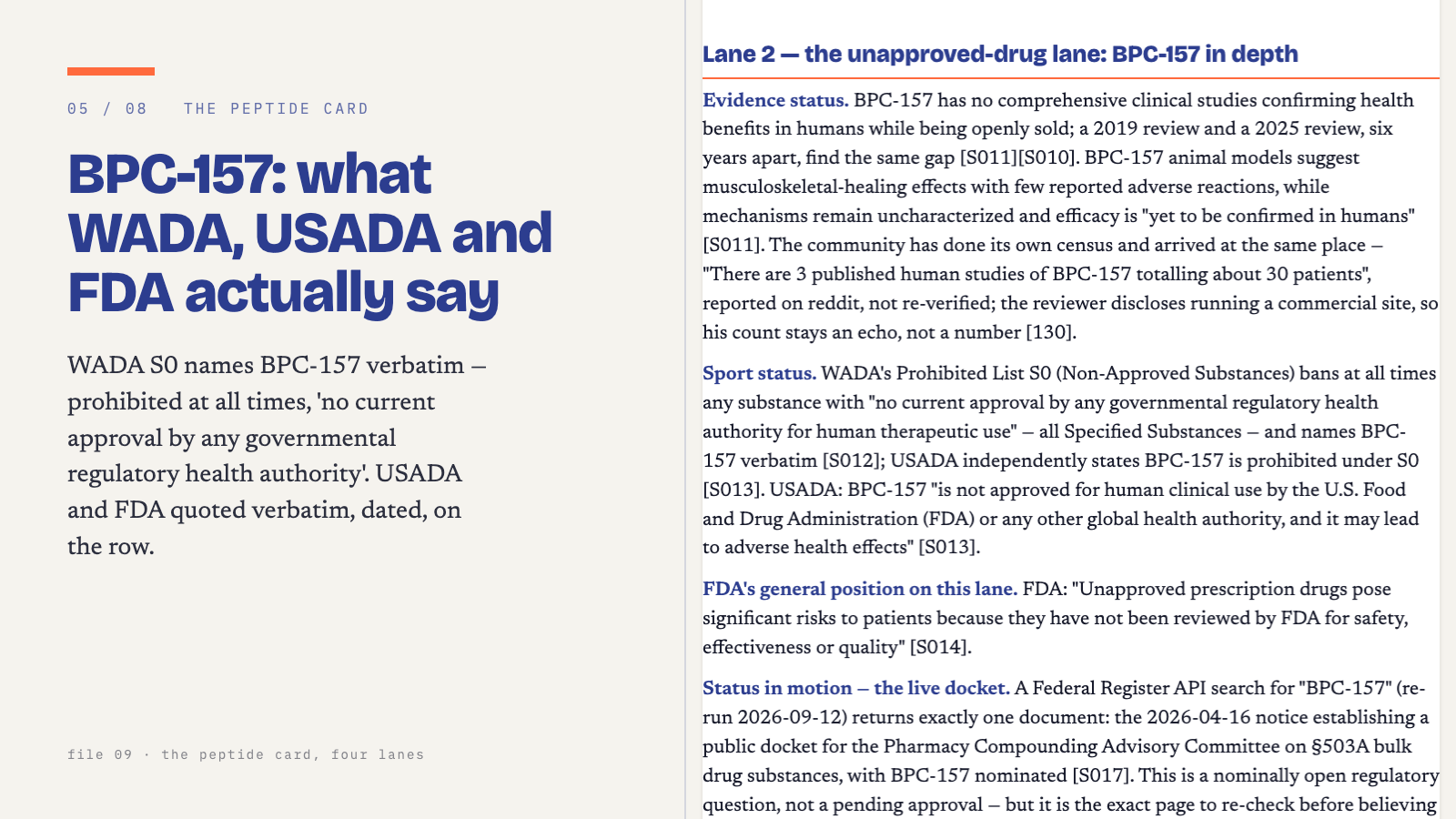
- The unapproved-drug lane. BPC-157 sits here while sold openly: no comprehensive human clinical studies confirming benefits (reviews from 2019 and 2025, six years apart, find the same gap); the Federal Register API returns exactly one BPC-157 document, the 2026-04-16 §503A compounding-advisory docket notice.
- The approved-drug lane, for contrast. Tesamorelin is approved, but only for HIV-associated lipodystrophy, per a 2026 sports-medicine review for orthopaedic physicians; any other use sits outside that approval, in the unapproved lane again.
Questions buyers actually ask
Is there an FDA guidance document specifically about peptides?
No single FDA guidance document is titled "peptides." The FDA regulates each peptide by the lane it falls into: an approved prescription drug (tesamorelin, for example, approved only for HIV-associated lipodystrophy, per a 2026 sports-medicine review), a compounded article reviewed under Section 503A, or a dietary supplement, which the FDA "does not approve" before it reaches a shelf (FDA 101, page dated 2025-03-03). No unified peptide policy sits above those three lanes.
What are the FDA's three lanes for a peptide, in plain words?
Lane one is the supplement lane. The FDA never pre-approves a dietary supplement, and a company "can often introduce a dietary supplement to the market without notifying the FDA" (FDA 101, 2025-03-03). Lane two is the unapproved-drug lane. The FDA states that unapproved drugs "have not been reviewed by FDA for safety, effectiveness or quality" (FDA Unapproved Drugs page, dated 2026-05-14). Lane three is the compounded-article lane under Section 503A, where a bulk substance is nominated and reviewed case by case, never cleared by one blanket peptide document.
Has the FDA said anything about BPC-157 specifically?
A Federal Register API search for "BPC-157" returns exactly one document as of 2026-09-12: the 2026-04-16 notice establishing a public docket for the Pharmacy Compounding Advisory Committee, with BPC-157 nominated under Section 503A. That is a nomination under review, not a guidance document and not an approval.
What about compounded GLP-1 peptides like semaglutide or tirzepatide?
The FDA states unapproved, compounded versions of GLP-1 drugs "do not undergo FDA's review for safety, effectiveness and quality before they are marketed," and recommends compounded drugs only where an FDA-approved drug cannot meet the patient's need, filled at a state-licensed pharmacy (FDA page, updated 2026-09-01). That is a specific FDA statement about one peptide class, not a general peptide guidance document.
Where do I check the current status myself?
Search the Federal Register directly for the peptide's name; a docket notice is a nomination under review, not an approval. Read the FDA's Unapproved Drugs page and FDA 101 page for the two lane-level statements quoted above. JAMA reported in June 2026 that unapproved peptide availability is likely to keep widening, so treat any status you find as dated, never permanent.
Price, and what this doesn't cover
One-time purchase. No subscription, no recurring charge.
The peptide card plus the graded map, the fill-in stack audit and the doctor questions. One afternoon, $29 once.
Sources (dated, checked 2026-09-13)
- FDA, Unapproved Drugs: fda.gov: unapproved drugs (page dated 2026-05-14)
- FDA 101, dietary supplements: fda.gov: FDA 101 dietary supplements (page dated 2025-03-03)
- Federal Register, PCAC public docket (BPC-157 nominated under Section 503A): federalregister.gov (2026-04-16)
- FDA, compounded semaglutide and tirzepatide (unapproved GLP-1 versions): fda.gov: semaglutide and weight loss (page updated 2026-09-01)
- JAMA, unapproved peptides coverage: doi.org/10.1001/jama.2026.6388 (2026-06-09)
- American Journal of Sports Medicine, peptide review for orthopaedic and sports-medicine physicians (tesamorelin's HIV-lipodystrophy approval): pubmed.ncbi.nlm.nih.gov/41476424 (2026-01)
- 2019 review, BPC-157: pubmed.ncbi.nlm.nih.gov/30915550 (2019-08-01)
- 2025 review, BPC-157: pubmed.ncbi.nlm.nih.gov/40005999 (2025-01-30)
- Bing autocomplete capture (osjson): api.bing.com/osjson.aspx (2026-09-11)
- Google Suggest autocomplete capture: suggestqueries.google.com (2026-09-11)