Is BPC-157 Legal? The Four Lanes, Regulator-Quoted
Why one word carries four answers
The same buyer asks it from different countries and different situations. A New Zealand buyer on an import forum asks, verbatim and quote-verified: "would it be much of a legal issue if they got intercepted?" Google Suggest shows the question is asked per-country: "is bpc 157 legal in india" was a live suggestion on 2026-09-11.
"How are peptides sold on the clearnet if theyre not legal?" (a buyer on r/Peptides; thread archived and quote-verified)
None of the free places to look resolves it per-country. The map's honest scoping: the lanes below cover the US and the UK, the two jurisdictions this guide's buyers live in, and say so.
What the wrong lane assumption costs
| If you assume… | The sourced reality |
|---|---|
| "Legal to buy = approved and reviewed" | FDA: unapproved drugs "have not been reviewed by FDA for safety, effectiveness or quality" |
| "Any online bottle is what the label says" | MHRA: online-sold products "may be fake, contaminated, incorrectly dosed, or contain powerful ingredients not listed on the packaging" [090] |
| "It's fine for my sport" | WADA S0 names BPC-157, prohibited at all times; Informed Sport (LGC) states it tests "every single sports supplements batch for banned substances before being released to market" [115], the contamination angle behind its mark |
Quotes as served on the linked pages, 2026-09-12.
Guides that answer a narrower slice were listed at $15–$87.90 across the stores checked on 2026-09-12; the bottle-testing membership lists at $75.00 for 1 year on consumerlab.com (2026-09-12). The card is the same $29 one-time as the whole map.
What you hold at the end
- Each lane on its own line, with the regulator's sentence, its date and its link, so "legal" stops being one tangled question.
- The per-country honesty rule: what the card covers (US + UK) and what it does not, named before you read.
- The tested-athlete line in plain words: S0, prohibited at all times.
- A dated watch-list: WADA's list is annual, the MHRA logs updates, the FDA docket is live; the card tells you which pages to re-check and when.
The four lanes, in the card's own order
TL;DR
- Drug lane: no FDA approval; USADA says so verbatim.
- Athlete lane: WADA S0, prohibited at all times, BPC-157 named.
- Shelf lane: the FDA "does not approve dietary supplements"; sold openly is distribution, not review.
- UK lane: the MHRA decides borderline status case by case and warns about unregulated online sellers [089][090].
- Lane 1, the US supplement lane. The FDA "does not approve dietary supplements"; companies "can often introduce a dietary supplement to the market without notifying the FDA"; the agency's regulating role "primarily begins after the product enters the marketplace". This is why a bottle can be everywhere and still never have been reviewed.
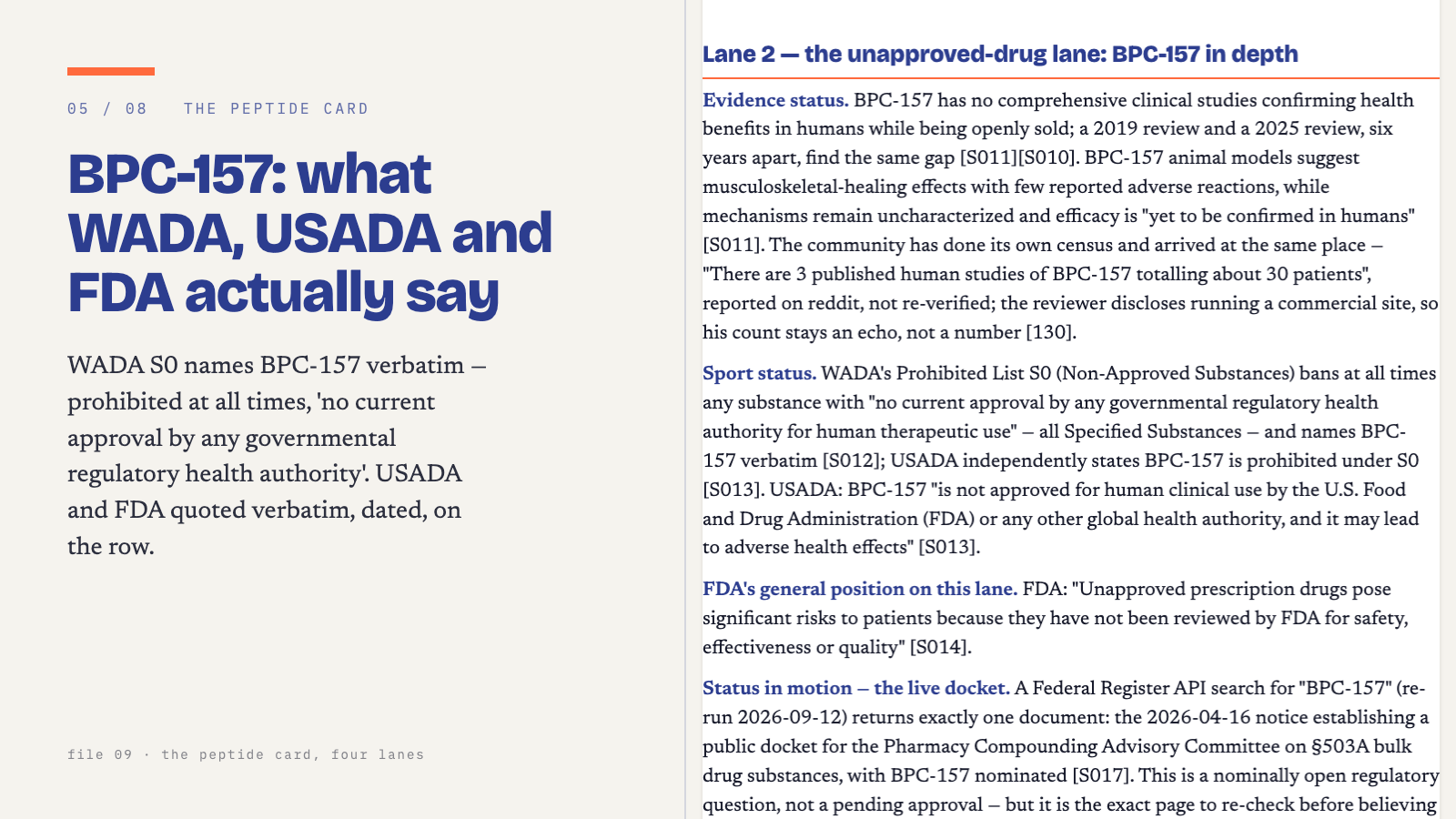
- Lane 2, the unapproved-drug lane. BPC-157 has no comprehensive human clinical studies while sold openly (2019 and 2025 reviews agree); the Federal Register carries exactly one BPC-157 document, the 2026-04-16 compounding docket.
- Lane 3, the boundary precedent. Vinpocetine is documented in the clinical literature as an unapproved drug sold as a dietary supplement, the case that shows the two shelves can hold the same substance in different legal boxes.
- Lane 4, the UK lane. The MHRA determines whether a product is a medicinal product, with food supplements a named borderline category until status is decided [089]; it warns that products sold by unregulated websites or social media "may be fake, contaminated, incorrectly dosed, or contain powerful ingredients not listed on the packaging" [090]; all GLP-1 medicines are prescription-only in the UK [090].
Questions buyers actually ask
Is BPC-157 legal to buy in the US?
Two facts sit side by side: the FDA does not approve dietary supplements at all, and BPC-157 is not an FDA-approved drug; USADA states it "is not approved for human clinical use by the U.S. Food and Drug Administration (FDA) or any other global health authority". So "legal to buy" describes availability, not regulatory review. The card prints both facts with dates.
Is it legal in the UK?
The MHRA determines whether a product is a medicinal product, with food supplements a named borderline category until status is decided [089]. It separately warns that products sold by unregulated online sellers "may be fake, contaminated, incorrectly dosed, or contain powerful ingredients not listed on the packaging" [090]. The UK lane in the card quotes these sentences verbatim, with the update log dated [091].
What about other countries (India, Australia, anywhere else)?
The question is genuinely per-country: "is bpc 157 legal in india" was a live Google suggestion on 2026-09-11. The card's honest scoping is US + UK, the jurisdictions its buyers live in; for anywhere else, the honest answer is a national regulator, not a forum.
I compete in a tested sport. Does the legality question change?
It hardens. WADA's S0 (Non-Approved Substances) prohibits at all times any substance with no current approval by any governmental regulatory health authority for human therapeutic use, and names BPC-157 verbatim on the current list. USADA carries the same position for US athletes.
If it's sold so openly, doesn't that mean it's fine?
Availability and approval are different facts. The FDA's unapproved-drugs page explains the risk class directly: they "have not been reviewed by FDA for safety, effectiveness or quality". JAMA reported in 2026 that unapproved peptides are likely to become more widely available, which makes the distinction more important, not less.
Price, and what this doesn't cover
One-time purchase. No subscription, no recurring charge.
Four lanes, regulator-quoted, plus the graded supplement maps and the fill-in stack audit. One afternoon, $29 once.
Sources (dated, checked 2026-09-12)
- WADA, The Prohibited List S0: wada-ama.org/en/prohibited-list (current annual list, page live 2026-09-11)
- USADA, BPC-157 peptide prohibited: usada.org/spirit-of-sport/bpc-157-peptide-prohibited (2020-03-03, modified 2026-08-10)
- FDA 101, dietary supplements: fda.gov: FDA 101 dietary supplements (2025-03-03)
- FDA, Unapproved Drugs: fda.gov: unapproved drugs (2026-05-14)
- MHRA/GOV.UK, borderline products: gov.uk: borderline products (2021-01-06, updated 2026-07-02)
- MHRA/GOV.UK, weight-loss medicines warning: gov.uk (2025-12-29)
- MHRA/GOV.UK, GLP-1 hub with update log: gov.uk: GLP-1 medicines (2025-06-05, updates through 2026-02-05)
- Federal Register, PCAC public docket: federalregister.gov (2026-04-16)
- JAMA, unapproved peptides coverage: doi.org/10.1001/jama.2026.6388 (2026-06-09)
- Vinpocetine precedent (Mayo Clin Proc): doi.org/10.1016/j.mayocp.2015.07.008 (2015)
- ConsumerLab membership pricing: consumerlab.com/join (as listed 2026-09-12)
- Buyer quotes: r/Peptides threads archived/verified via Wayback and pullpush