Which Supplements Should I Take? Answer It Goal-First
Why the question never closes when asked substance-first
The question is asked everywhere, and the answers never land. A community thread is titled, verbatim, "What supplements should I be taking?". Google Suggest surfaces the same words raw: "which supplements should i take / daily / for hair growth / for weight loss / at night", typed demand, live 2026-09-11. And the people following the loudest source of supplement talk describe the result:
"I am overwhelmed by the number of supplements he said he takes regularly" (a listener of the same episodes, writing to a community; thread archived and quote-verified)
Here is the loop the listener describes: each new episode adds a bottle, admiration blocks dismissal ("the knowledge is amazing", same thread), and the shelf grows faster than the understanding. One poster put his own verdict on the stack size bluntly: "I felt this is clearly not normal".
What answering it the old way costs
| The old route | What it costs, sourced |
|---|---|
| Buying the podcast stack wholesale | At the 2022 partnership announcement, Momentous listed a "Huberman Lab Complete Product Bundle" at $384.40, "a starter pack to adopt Huberman protocols" |
| Paying for narrower curation | The bottle-testing membership lists at $75.00 for 1 year ($125.00 for 2) on consumerlab.com (2026-09-12) |
| Buying a guide that promises directions | A supplement handbook with a form-selection module was listed at $57 (48 ratings, 5.0) as listed on its store 2026-09-12 [142] |
| Doing nothing and keeping the shelf | Every conditional row stays ungraded, every bottle stays a guess |
Prices as listed on the linked stores on 2026-09-12; the bundle figure is the 2022 announcement, not today's price.
What you hold at the end
- A graded map per goal: muscle, cognition, mood, general health (omega-3 two-sided), testosterone support, sleep, longevity, energy; every grade carries its source marker, resolvable in the sources file.
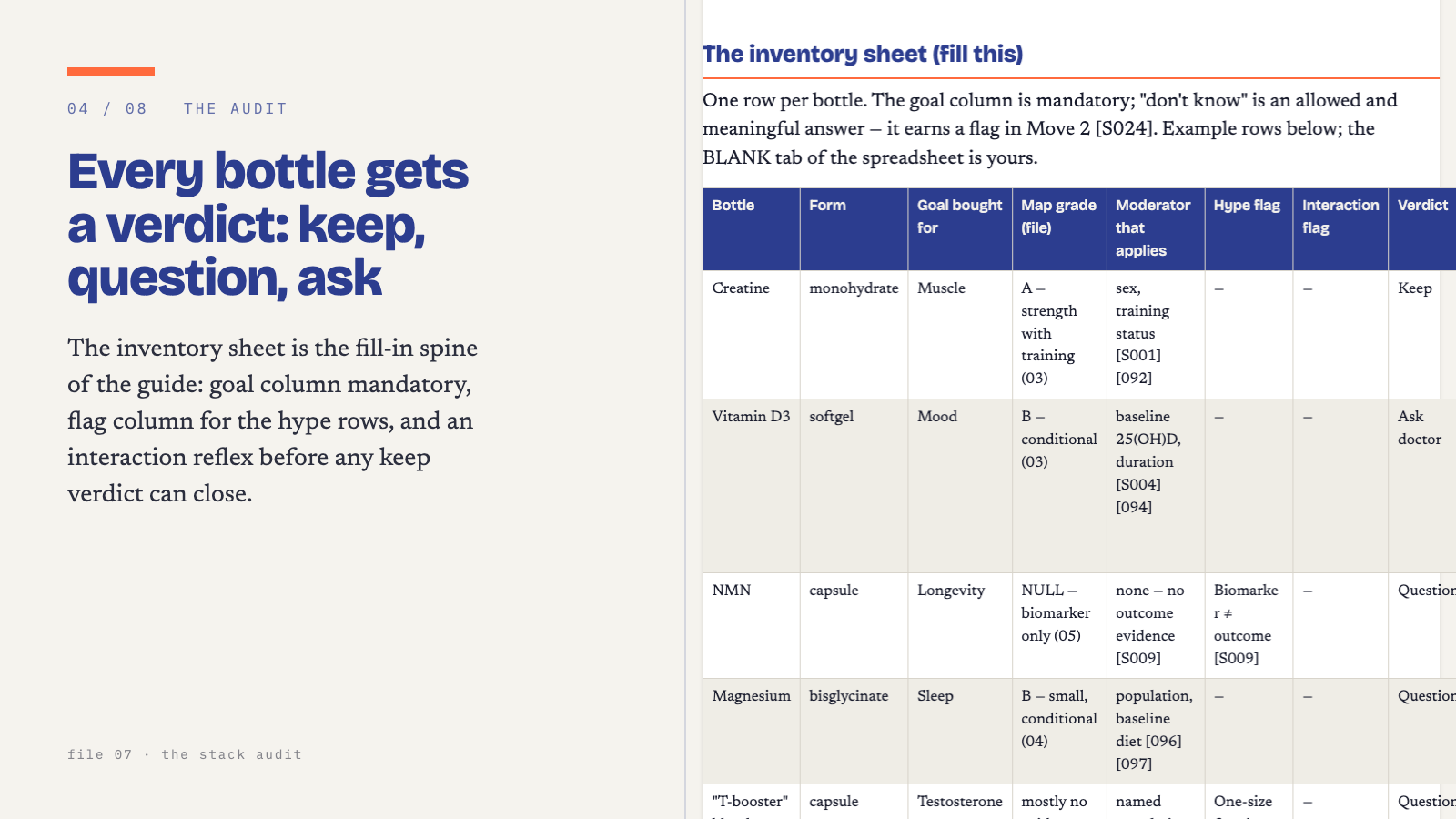
- Your own filled stack audit: per bottle, keep / question / ask-doctor, with the interaction reflex before any "keep" closes.
- The hype-flag layer: biomarker-is-not-outcome, regulator-rejected claims, one-size framing, "energy" marketing, applied to your rows, not abstractly.
- The bloodwork-and-doctor one-pager: the markers the conditional rows hang on, written questions, dated US/UK lab routes (as listed 2026-09-12).
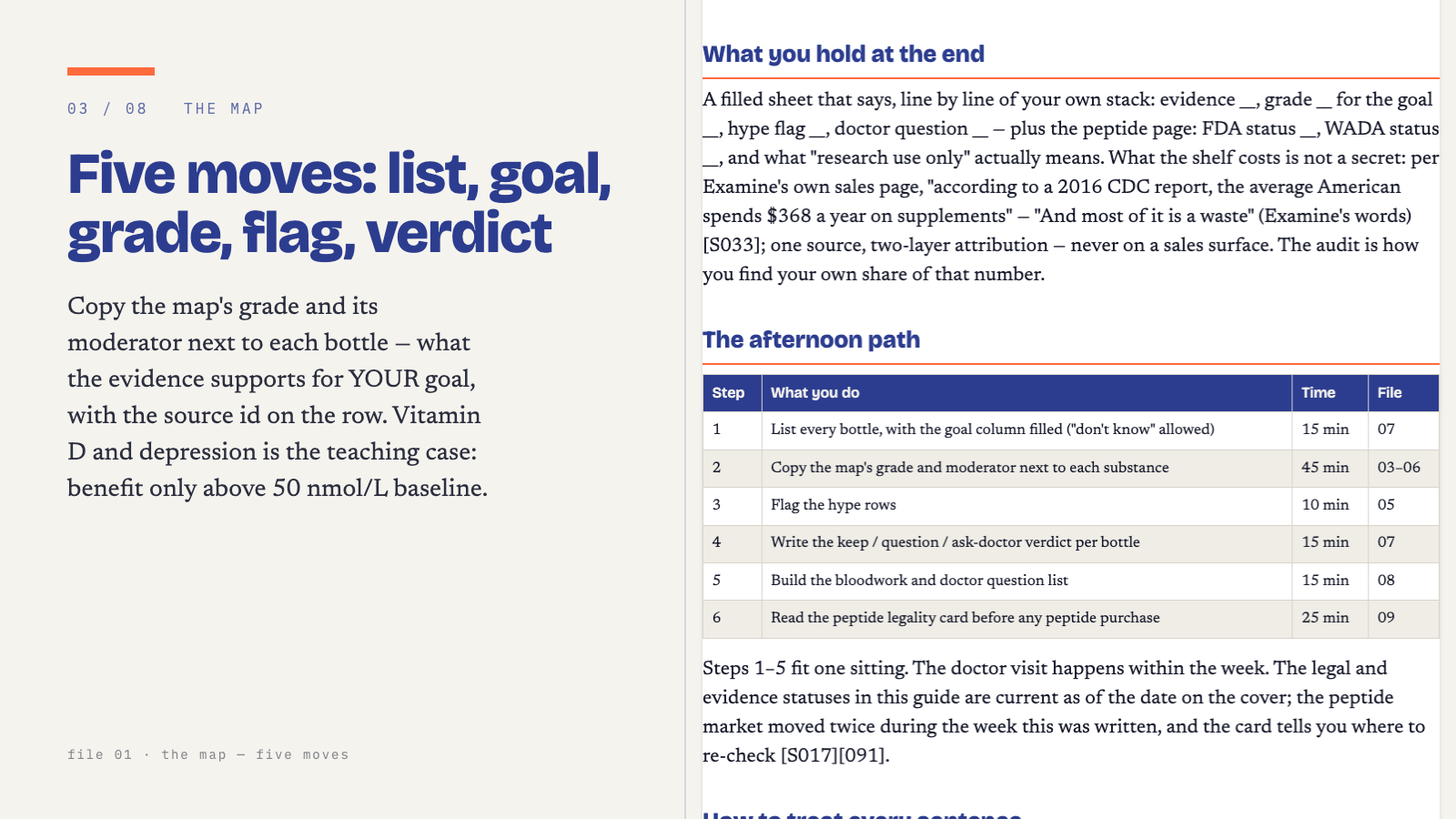
The five moves
TL;DR
- LIST every bottle; "don't know" is an allowed, meaningful answer.
- One goal per bottle, in your own words; the grade answers "for THIS goal", never "is this a good supplement".
- COPY the grade and its moderator: the conditions the evidence depends on travel with the number.
- FLAG the hype rows; VERDICT per bottle: keep, question, or ask your doctor.
The teaching case for why goal-first changes the answer: vitamin D and depression. Pooled benefit only where baseline 25(OH)D exceeded 50 nmol/L, none below that threshold; each 1000 IU/day D3 slightly reduced depressive symptoms (SMD −0.32), strongest in trials up to 8–24 weeks, null beyond 52 weeks, no anxiety effect [094]. Same substance, different goals and baselines, different answers. That is what a moderator is, and it is why the goal column is mandatory.
Muscle rows: creatine plus resistance training increases strength in adults under 50, with greater pooled gains in males than females; on top of RT alone, creatine increased lean body mass by 1.14 kg (95% CI 0.69–1.59) [108]. Omega-3 is graded two-sided by design: no broad benefit signal, with a dose-dependent atrial-fibrillation signal above 1.5 g/day in meta-analyses [095][107]. All evidence-grade observations, never intake advice.
Questions buyers actually ask
NIH fact sheets are free and official. Why pay?
Because NIH ODS is substance-indexed: it answers per substance, not per goal, and it issues no verdicts for a shelf. The map's job is different: grades attached to goals, a moderator on each row, and a fill-in audit that ends with keep / question / ask-doctor. The free sheets are the right first stop for one substance; the map is the instrument for a whole stack.
Examine.com already grades the research. Why pay?
Examine's own pages say what it is: a Navigator that is "Search by condition to find supplement efficacy, safety, and dosage information" and Guides promising "Step-by-step directions on what supplements to take, how much, and when", condition-indexed, directions-first, no stack audit, no peptide status card. Its homepage carries zero mentions of "peptide", "stack" or "audit" (served page, 2026-09-11).
ConsumerLab already tests supplements. Why pay?
ConsumerLab tests bottles, a different job from grading evidence by goal and auditing your own stack. A member's own words describe the habit it serves: "I don't buy anything anymore without searching the best from your findings" (member testimonial on a dynamic page, re-capture before quoting). Its membership lists at $75.00 for 1 year (2026-09-12). Complementary, not competing.
My doctor can just tell me what to take.
Prescribers themselves report the gap. "Patients are asking me for BPC, CJC, and others that are not legal", writes a licensed prescriber on a peptide forum. The map prepares that appointment instead of skipping it: inventory, grades and written questions on one page. It never replaces your doctor.
Huberman takes them, so they work.
That is the framing that built the shelf: at the 2022 partnership announcement, Momentous listed a "Huberman Lab Complete Product Bundle" at $384.40, "a starter pack to adopt Huberman protocols". The map swaps "does the guru take it" for a grade per goal and its moderator, and the same pill does different things at different baselines.
Is this a subscription?
No. $29 once, and it doesn't expire. The map is information, not professional advice; it never prescribes a dose, a protocol, or a place to buy.
Price, and what this doesn't cover
One-time purchase. No subscription, no recurring charge.
Eight graded goal maps, the fill-in stack audit, the doctor page and the peptide card. One afternoon, $29 once.
Sources (dated, checked 2026-09-12)
- NIH ODS, fact sheets: ods.od.nih.gov/factsheets (living fact sheets, archived copy checked 2026-09-06)
- Vitamin D × depression meta-analysis: pubmed.ncbi.nlm.nih.gov/39552387 (2024-11-18)
- Creatine + RT strength meta-analysis: pubmed.ncbi.nlm.nih.gov/41328071 (2025-11-27)
- Creatine LBM meta-analysis: pubmed.ncbi.nlm.nih.gov/39074168 (2024-07-23)
- Omega-3 AF meta-analysis: pubmed.ncbi.nlm.nih.gov/42144851 (2026-06-01)
- Omega-3 review: pubmed.ncbi.nlm.nih.gov/39617283 (2024-11-30)
- Examine homepage (served text): examine.com snapshot 2026-09-10
- ConsumerLab membership pricing: consumerlab.com/join (as listed 2026-09-12)
- Momentous × Huberman announcement (archived): livemomentous.com, 2022-11-30
- Google Suggest capture: suggestqueries.google.com (2026-09-11)
- Buyer quotes: community threads archived/verified