BPC-157 Safety: What the Human and Animal Evidence Actually Shows
Why this question keeps getting typed
The corpus behind this card shows the safety phrasing arriving in the same breath as the legal one: both were live autocomplete suggestions on the same search session, typed by people who cannot find a plain answer to either. The demand is not abstract. A reddit user, quote-verified, asked for exactly what the evidence actually says, not for an opinion: "what's the evidence that it needs to be cycled off?", "I am not looking for opinion, but rather evidence based." Nobody in the thread answered with a citation.
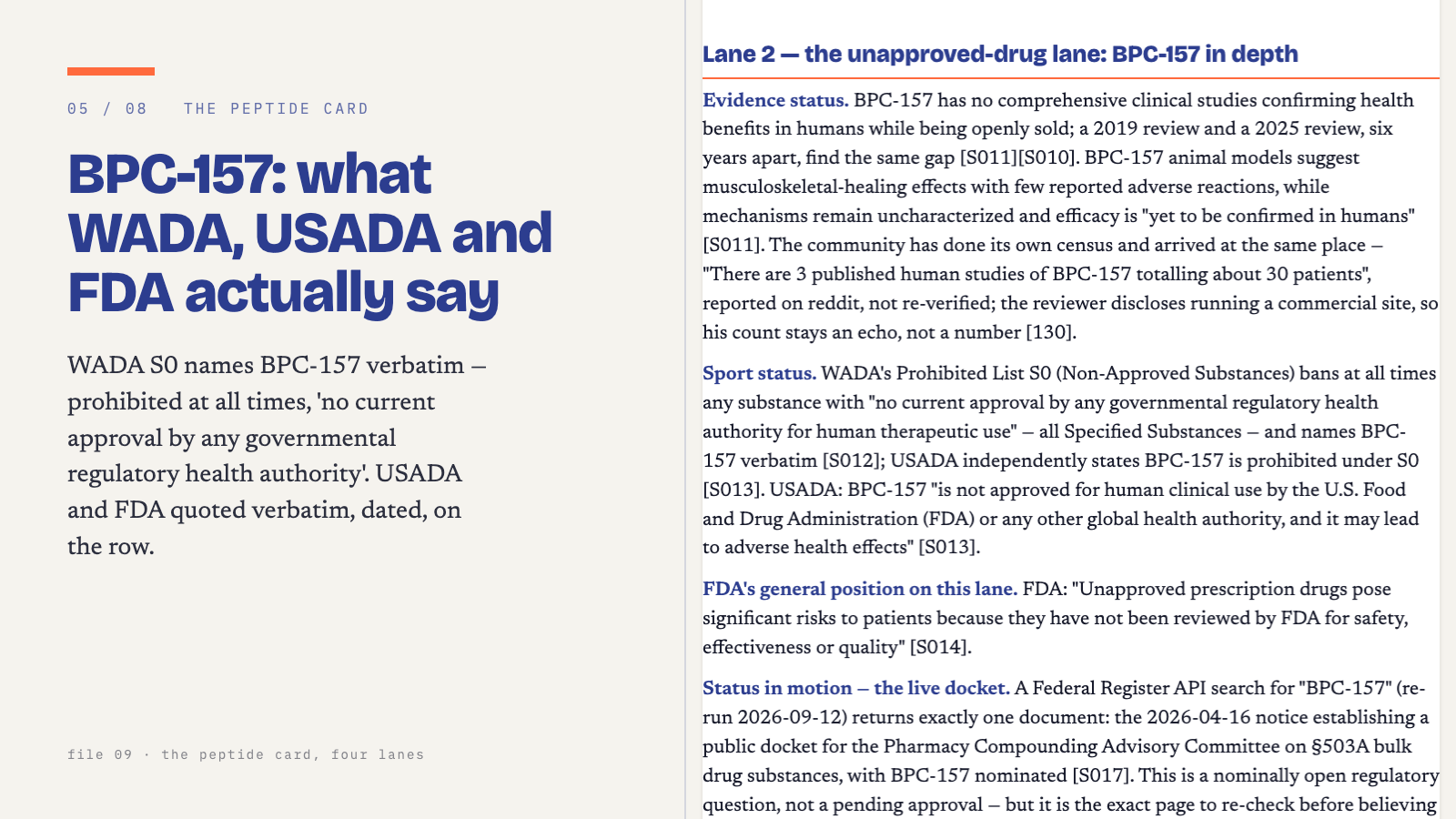
"There are 3 published human studies of BPC-157 totalling about 30 patients" (a buyer's own count on r/Peptides, thread archived and quote-verified; the same poster discloses running a commercial peptide site, so the number travels as an echo, not a verified figure)
None of the free places to look resolve the question with a dated primary source. This page does for BPC-157 specifically; the full card grades every substance on the shelf the same way.
What assuming "no news is good news" costs you
| If you assume… | The sourced reality |
|---|---|
| "No adverse reports online, so it must be fine" | Two independent reviews, 2019 and 2025, found no comprehensive human clinical studies confirming BPC-157's benefits or establishing its safety profile |
| "Animal studies looked fine, so humans will react the same way" | The 2019 review reports few adverse reactions in animal models while stating plainly that the healing mechanisms are still not understood; human efficacy has not been confirmed |
| "It's a peptide, not a real drug, so the bar is lower" | USADA: BPC-157 "is not approved for human clinical use… and it may lead to adverse health effects"; two 2026 clinician reviews describe the wider gray-market peptide shelf as having scarce rigorous human safety data, with potential for serious harm |
Quotes as served on the linked pages, checked 2026-09-13.
Guides answering a narrower slice of the peptide question were listed at $9.99 to $87.90 across the stores checked on 2026-09-13. The card folding this read into the full evidence-and-legality map is the same $29 one-time.
What you hold at the end
- Each substance's evidence status on its own line, human data separated from animal data, dated and linked, so "no news" stops reading as a green light.
- The same per-substance table for the other nine gray-market peptides on the shelf: TB-500, CJC-1295 with ipamorelin, tesamorelin, GHK-Cu and the rest.
- The tested-athlete line in plain words: WADA's S0 category, prohibited at all times, independent of the evidence question.
- A dated watch list: the Federal Register docket is live, JAMA's coverage of peptide availability is ongoing; the card tells you which pages to re-check and when.
How to actually answer this for yourself, in order
TL;DR
- No comprehensive human clinical trials exist for BPC-157, confirmed by two independent reviews six years apart.
- Animal studies report few adverse reactions, but the healing mechanisms remain uncharacterized.
- USADA states plainly that BPC-157 may lead to adverse health effects; WADA prohibits it at all times under S0.
- Two 2026 clinician reviews find the wider gray-market peptide shelf has scarce rigorous human safety data, with potential for serious harm, in a market operating largely outside regulatory oversight.
- Separate two different claims. "Nobody online reports a disaster" is not the same claim as "this has been reviewed for safety." Only the second one would actually answer the question, and no source in this corpus makes it.
- Read the human evidence first. A 2025 review in Pharmaceuticals and a 2019 review in Cell and Tissue Research, six years apart, both conclude the same thing: no comprehensive human clinical studies confirm BPC-157's benefits or establish its safety profile.
- Read the animal evidence next, and notice where it stops. The 2019 review reports musculoskeletal-healing effects with few adverse reactions in animal models, while stating the precise mechanisms are still not understood.
- Read the regulatory language once, not the marketing copy. USADA: BPC-157 "is not approved for human clinical use by the U.S. Food and Drug Administration (FDA) or any other global health authority, and it may lead to adverse health effects." The FDA's general rule for unapproved drugs is that they "have not been reviewed by FDA for safety, effectiveness or quality."
- If sport eligibility applies to you, treat that part as already decided. WADA's S0 category prohibits BPC-157 at all times; no amount of evidence-reading changes that status.
- Take dosing, cycling or sourcing questions to a doctor. None of that is answered anywhere in this corpus, on purpose, and no page in this map answers it either.
The hard part
The honest state of the evidence is not a verdict, it's an absence. No comprehensive human clinical trial has confirmed or ruled out real-world outcomes for BPC-157, and that gap has held for at least six years across two independent reviews, 2019 and 2025, while the substance kept selling the entire time. An absence of human trials is not the same as an absence of risk, and it isn't the same as evidence of risk either. Both readings go further than what the reviews actually say.
It gets harder once you add the rest of the shelf. Two 2026 clinician reviews, in Sports Medicine and the American Journal of Sports Medicine, looked at the same gray-market peptide category, BPC-157 alongside CJC-1295, ipamorelin, TB-500 and others, and both describe rigorous human safety data as scarce, with potential for serious harm to patients, in a market operating largely outside regulatory oversight. That's not one outlier paper; it's two independent clinician-facing reviews agreeing on the same structural gap, a year apart, about the class BPC-157 belongs to.
And the buyer's own community keeps running into the same wall. One widely referenced count puts the human literature at three published studies totalling about 30 patients, but the person doing the counting also runs a commercial peptide site, so the number travels as an echo, not a verified figure. Meanwhile JAMA reported in mid-2026 that unapproved peptides are likely to become more widely available under the current FDA posture, which means more people will ask this exact question while the evidence gap stays exactly where it is.
Questions buyers actually ask
What does the evidence actually say about BPC-157's safety in humans?
Two independent peer-reviewed reviews, six years apart, agree on the same gap: no comprehensive human clinical studies confirm BPC-157's benefits or establish its safety profile in people. One, in Pharmaceuticals (2025), states directly that comprehensive clinical studies confirming health benefits in humans are missing. The other, in Cell and Tissue Research (2019), reports few adverse reactions in the animal literature while stressing that the precise healing mechanisms still need to be understood. Neither reaches a human verdict, because neither has the trials to reach one.
Has BPC-157 actually been tested in clinical trials on people?
Not in any comprehensive way. One reddit user counted three published human studies totalling about 30 patients, a figure worth naming but not a verified count, since the same person discloses running a commercial peptide site. What two independent reviews confirm instead is the structural fact: comprehensive human clinical trials for BPC-157 do not exist yet, despite years on the open market.
What do the animal studies show, and where do they stop?
The 2019 review found animal models, tendon, ligament, muscle and bone, showing beneficial effects on healing after various insults, with few adverse reactions reported in the literature. It also states plainly that the precise healing mechanisms still need to be understood for the therapy to reach clinical use. That is animal-model promise, not a human evidence base, and the two should not be read as the same thing.
Does the safety question change if I compete in a tested sport?
It hardens, separately from the evidence question. WADA's S0 category prohibits BPC-157 at all times because it has no current approval by any governmental regulatory health authority for human therapeutic use; USADA independently confirms the same prohibited status and adds its own line: BPC-157 is not approved for human clinical use by the FDA or any other global health authority, and it may lead to adverse health effects. For a tested athlete, that status question is already settled before the evidence question even starts.
If it's sold everywhere with no obvious scandal, doesn't that mean it's basically fine?
Two 2026 clinician reviews, published in Sports Medicine and the American Journal of Sports Medicine, looked at exactly that reasoning across the gray-market peptide shelf, BPC-157 included, and found rigorous human safety data scarce, with potential for serious harm to patients, in a market operating largely outside regulatory oversight. Open availability describes distribution, not a completed review; the FDA states the same principle for unapproved drugs generally, that they have not been reviewed by FDA for safety, effectiveness or quality.
Price, and what this doesn't cover
One-time purchase. No subscription, no recurring charge.
Every peptide on the shelf, evidence and regulatory status graded the same way, plus the stack audit and the doctor questions. One afternoon, $29 once.
Sources (dated, checked 2026-09-13)
- USADA, BPC-157 peptide prohibited: usada.org/spirit-of-sport/bpc-157-peptide-prohibited (2020-03-03, modified 2026-08-10)
- WADA, The Prohibited List S0: wada-ama.org/en/prohibited-list (current annual list, page live 2026-09-11)
- FDA, Unapproved Drugs: fda.gov: unapproved drugs (2026-05-14)
- FDA 101, dietary supplements: fda.gov: FDA 101 dietary supplements (2025-03-03)
- Pharmaceuticals (MDPI), BPC-157 literature and patent review: pubmed.ncbi.nlm.nih.gov/40005999 (2025-01-30)
- Cell and Tissue Research (Springer), BPC-157 musculoskeletal-healing review: pubmed.ncbi.nlm.nih.gov/30915550 (2019-08-01)
- Sports Medicine (Springer Nature), gray-market peptide review: pubmed.ncbi.nlm.nih.gov/41966639 (2026-04-12)
- American Journal of Sports Medicine (SAGE/AOSSM), per-substance peptide review: pubmed.ncbi.nlm.nih.gov/41476424 (2026-01-01)
- Federal Register, PCAC public docket: federalregister.gov (2026-04-16)
- JAMA, unapproved peptides coverage: doi.org/10.1001/jama.2026.6388 (2026-06-09)
- Buyer quotes: r/Peptides threads archived and quote-verified via Arctic Shift