My Wife Doesn't Want Me Anymore? "Loved" and "Wanted" Are Two Different Questions
The question, and why it splits in two
The typed record shows the split, on the men's side of this exact pain. On Google: "my wife doesn't want me anymore." On Bing: "why does my wife not want me", "wife doesn't want me anymore", "feeling unwanted in a relationship". Men type this at the same hour their wives type the mirror version of it.
"I don't even care about sex. I just want to hug my wife." (reported on Reddit, not re-verified)
The frame this kit ships is one attributed sentence at a time. In Esther Perel's framing, "love is about having, and desire is about wanting," while "the very qualities that nurture intimacy can be sexually deflating". Read together with the clinical record (desire discrepancy named and studied continuously since 2001), the practical consequence is the same for either spouse: separating the two questions in writing, before the conversation, keeps it from becoming an accusation.
One honesty note, up front. This kit was written first from the higher-desire wife's side, because that is the flank the loudest search volume points to. But every script inside runs both directions, hers to him and his to her, and the 30-day protocol is built to start from whichever side picks it up first. If you are the husband reading this tonight, you are getting the same sourced material she would get, not a smaller or bolted-on version of it. We would rather say that plainly than let a disappointed buyer find out later.
What people pay before they find this
| What gets tried | Listed cost | What it actually covers |
|---|---|---|
| The anchor book (2003), 4.3★ / 864 ratings | $13.99 Kindle | Explains the pattern; its own critical reviews say "without both parties in the relationship reading the book it is useless" |
| The evidence-based online program | $249 / $99 / $79 | General relationship distance, not desire |
| Gottman's 30-day journal | $30.00 | Couples-general, daily email, not printable tonight |
| The apps (Paired, Evergreen) | Free + subscription inside, amounts not exposed | General couples content; assumes two willing partners |
Prices as observed 2026-09-11; each row's source is linked in the sources list at the bottom of this page. App subscription amounts are not exposed on the listings.
What you hold at the end of the evening
- The two questions (loved? wanted?) written down separately, so the conversation can't conflate them.
- The lane you are in named honestly: stress, responsive desire, or the medical check.
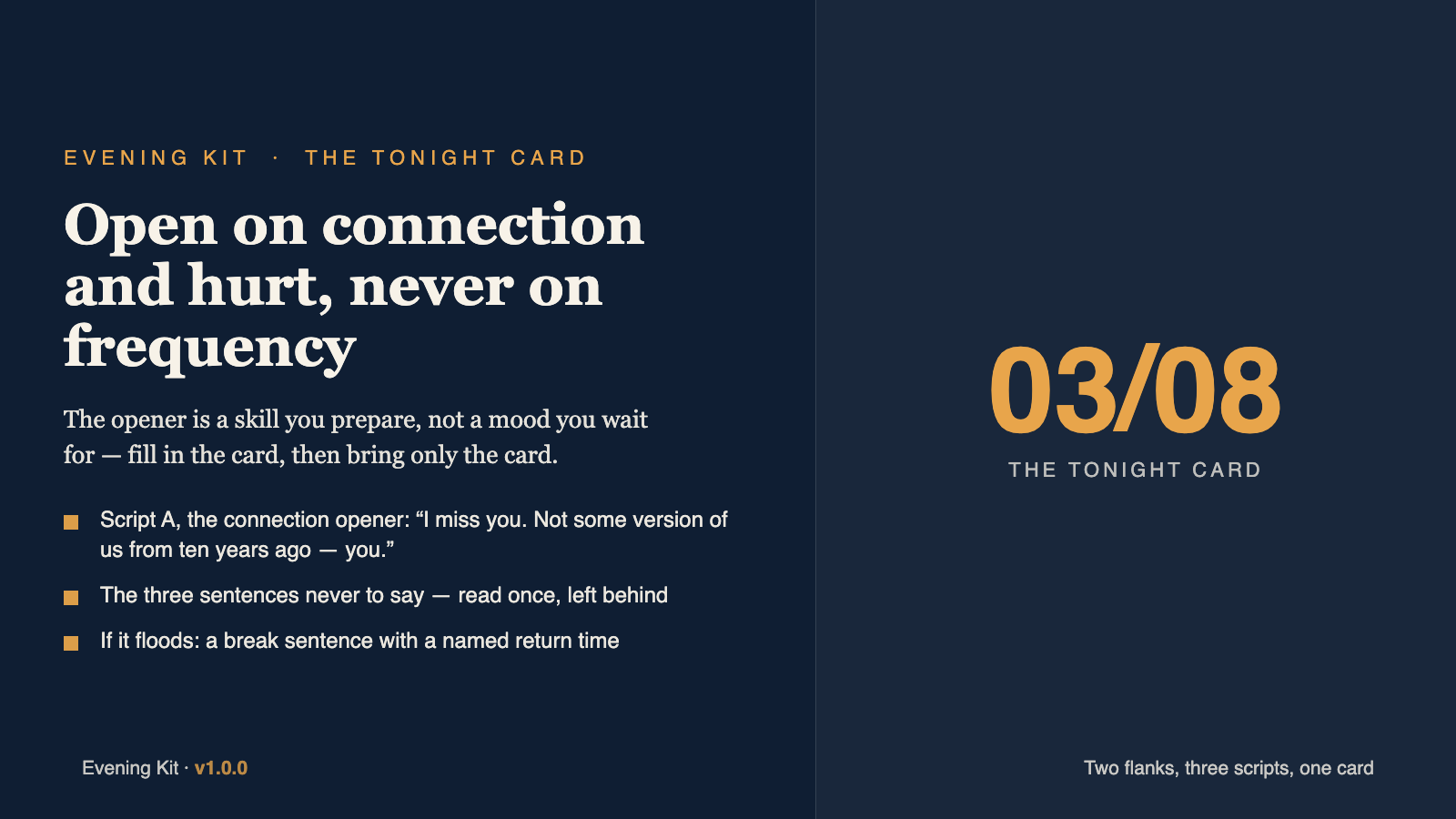
- A filled-in tonight card: opener, time, place, the three sentences crossed out, the plan B agreed.
- Day 1 of a 30-day protocol that starts from your side, whichever side that turns out to be.
The three lanes, and the opener for tonight
TL;DR
- Separate "does she love me" from "does she want me", in writing, before you speak.
- Lane 1: chronic stress lowers desire in daily-life studies, hers and yours both.
- Lane 2: desire in long-term couples is often responsive; it arrives after closeness, not before it.
- Lane 3: sudden change, pain, or a medical lane worth naming. HSDD is one of the most common female sexual dysfunctions, and only a doctor can check it.
- Then: the opener tonight, prepared, on connection and hurt, never frequency, with scripts for both directions inside the same kit.
- Write the two questions down, separately. Autocomplete shows men typing the want-question ("wife doesn't want me anymore") on the same engines women use for the love-question; the conversation goes wrong when one is used to answer the other.
- Check the stress lane. Higher subjective stress on a given day is associated with a lower likelihood of concurrent sexual desire, tracked bidirectionally over 14 days. It cuts both ways, which makes both your stress levels a lever, not a verdict.
- Check the desire lane. In long-term couples, desire is frequently responsive: it shows up after arousal and closeness. Her not reaching for you first is not proof that the wanting is gone.
- Route the medical lane. The ICSM 2024 consensus names HSDD, hypoactive sexual desire disorder, as "one of the most common female sexual dysfunctions." A sudden change, pain, or a new medication books the appointment; it is a question for a doctor, not a verdict on the marriage. The kit lists the questions to bring.
- Then open the conversation. Prepared, not improvised: written opener, connection and hurt first, the three sentences never to say crossed out, a timed break with a return time as the plan B. The scripts run in both directions, because on any given night either one of you might be the one opening it.
The hard part: the "roommates" phrase is common language, not a diagnosis
The phrase appears in a husband's own mouth ("she feels more like a roommate or the mother of our kids", reported on Reddit, not re-verified), in a Gottman article's opening ("it feels like we're just roommates"), and in vendor copy on both flanks' listings. It describes the situation; it diagnoses nothing. And no sentence opens an avoidant partner on its own: "Avoidant mates do not open because you found a gentler sentence," as one couples-therapy practice writes.
Questions people actually ask
Does my wife still love me if she doesn't want me?
The two questions split on the search engines the same way they do for the other flank of this pain, and Esther Perel's framing separates desire from love. The kit's position is simple: separate the two questions in writing before you speak, because conflating them turns the conversation into an accusation.
Why would she stop wanting me if nothing is wrong?
Three documented lanes. Chronic stress measurably lowers desire. Desire is often responsive in long-term couples; it arrives after closeness. And HSDD, named as one of the most common female sexual dysfunctions by the ICSM 2024 consensus, is a medical lane only a doctor can check. None of the three is a verdict on you.
How do I bring it up without it becoming a fight?
Prepare it like a skill. Write the opener first, open on connection and hurt rather than frequency, cross out the three sentences never to say, and agree a timed break with a return time as the plan B.
Was this kit written for men, or is this page a repurposed version of the wife's kit?
Honestly: the kit was written first from the higher-desire wife's side, because that flank carries the louder search volume. But the scripts run in both directions from page one, hers to him and his to her, and the 30-day protocol is built to start from whichever side picks it up first. Buying it as the husband gets you the same sourced material she would get, not a smaller version of it.
Is this a subscription?
No. One-time $29, printable tonight, no recurring charge. For comparison, the anchor book is $13.99 on Kindle, the program is $249/$99/$79, and Gottman's journal is $30.00.
What does the kit NOT cover?
It does not diagnose or treat; it does not promise an outcome; it does not replace a doctor or a sex therapist credentialed by AASECT. And it cannot open a partner who will not engage; the solo-start path exists precisely because of that limit.
Price, and what this doesn't cover
One-time purchase. No subscription, no recurring charge.
He Stopped Initiating: The 'Bring It Up Tonight' Kit. Both flanks' scripts, the three lanes explained, the tonight card, and the 30 days that start solo, from whichever side goes first. $29 once.
Sources (dated, checked 2026-09-11/17)
- Google autocomplete, "my wife doesn't want me anymore" among completions: suggestqueries.google.com (live 2026-09-11)
- Bing autocomplete, "why does my wife not want me" and "wife doesn't want me anymore" among completions: api.bing.com (live 2026-09-11)
- Perel, "love is about having, and desire is about wanting" (archived copy): estherperel.com via Wayback (2013-02, live 404)
- Desire discrepancy named and studied, 2001-2026: doi.org/10.1080/14681994.2012.678825 (2012); pooled FSD prevalence study doi.org/10.1186/s12905-025-03960-4 (2025)
- Stress and desire, bidirectional, 14-day daily-diary study: doi.org/10.1093/abm/kaaf007 (2025-01)
- HSDD named "one of the most common female sexual dysfunctions" (ICSM 2024 consensus): doi.org/10.1093/sxmrev/qeaf057 (2025-10-15)
- Buyer voices, Reddit via Wayback, reported only: "I don't even care about sex. I just want to hug my wife." reddit.com/r/DeadBedrooms (est. 2023-01, snapshot archived 2025-03-06); "when I try to initiate something and she shuts me down, I feel hurt" reddit.com/r/DeadBedrooms (2024-12-10); "she feels more like a roommate or the mother of our kids" reddit.com/r/DeadBedrooms (2024-10-15)
- "It feels like we're just roommates" opening line, Gottman: gottman.com (2025-10-16)
- Avoidant mates quote: couplestherapyinc.com (2025-01-22, updated 2026-08-28)
- The Sex-Starved Marriage, $13.99 Kindle / 4.3★ / 864 ratings; 1★ theme quoted: amazon.com (live 2026-09-11)
- OurRelationship pricing $249/$99/$79: ourrelationship.com (page modified 2026-08-10)
- Gottman 30-day journal $30.00: gottman.com (modified 2026-03-19)
- Paired app 4.73★/207,000+; Evergreen 4.82★/54,000+ (counts as of 2026-09-12); free + subscription inside: itunes.apple.com · itunes.apple.com
- AASECT continuing-education training, "Talking About Sex in Psychotherapy: Why It Matters, How and When to Do It": aasect.org via Wayback (2025-11-13)