My Husband Stopped Initiating Intimacy: What To Do Tonight
The reaching stopped: what the sources say it means
The question is typed often enough that Google completes it: "my husband stopped initiating intimacy" is one of the engine's own completions, observed live on 2026-09-11, alongside "why doesn't my husband want me" and "why doesn't my husband want me after 5 years", and, on Bing, "why doesn't my husband love me anymore".
"easily the fifth time we've had the talk this year" (reported on Reddit, not re-verified)
The pattern is documented, not imagined: sexual desire discrepancy has been a named, continuously studied phenomenon in peer-reviewed journals from 2001 to 2026. A 2014 peer-reviewed paper titles it "a Feature, Not a Bug, of Long-Term Relationships".
What people pay before they find this
Before most people reach a working sequence, the shelf looks like this (prices as observed 2026-09-11):
| What gets tried | Listed cost | What it actually covers |
|---|---|---|
| The anchor book (2003), 4.3★ / 864 ratings | $13.99 Kindle | Explains the pattern; its own critical reviews repeat one theme: "without both parties in the relationship reading the book it is useless" |
| The evidence-based online program | $249 / $99 / $79 | General relationship distance; solo completion is sold, but desire is not its target |
| Gottman's 30-day journal | $30.00 | Couples-general, no desire content, arrives by daily email, not printable tonight |
| The apps (Paired, Evergreen) | Free to download, subscription inside, amounts not exposed | General couples content; assumes two willing partners |
Prices as observed 2026-09-11; each row's source is linked in the sources list at the bottom of this page. Review counts are platform displays, not averages, and app subscription amounts are not exposed on the listings.
What you hold at the end of the evening
- A filled-in one-page tonight card: the opener you chose, the time and place, the three sentences you will not say, crossed out.
- Day 1 of a 30-day protocol that starts from your side only, whatever his answer was tonight.
- A plan B written before you need it: a timed break with a return time, agreed in advance.
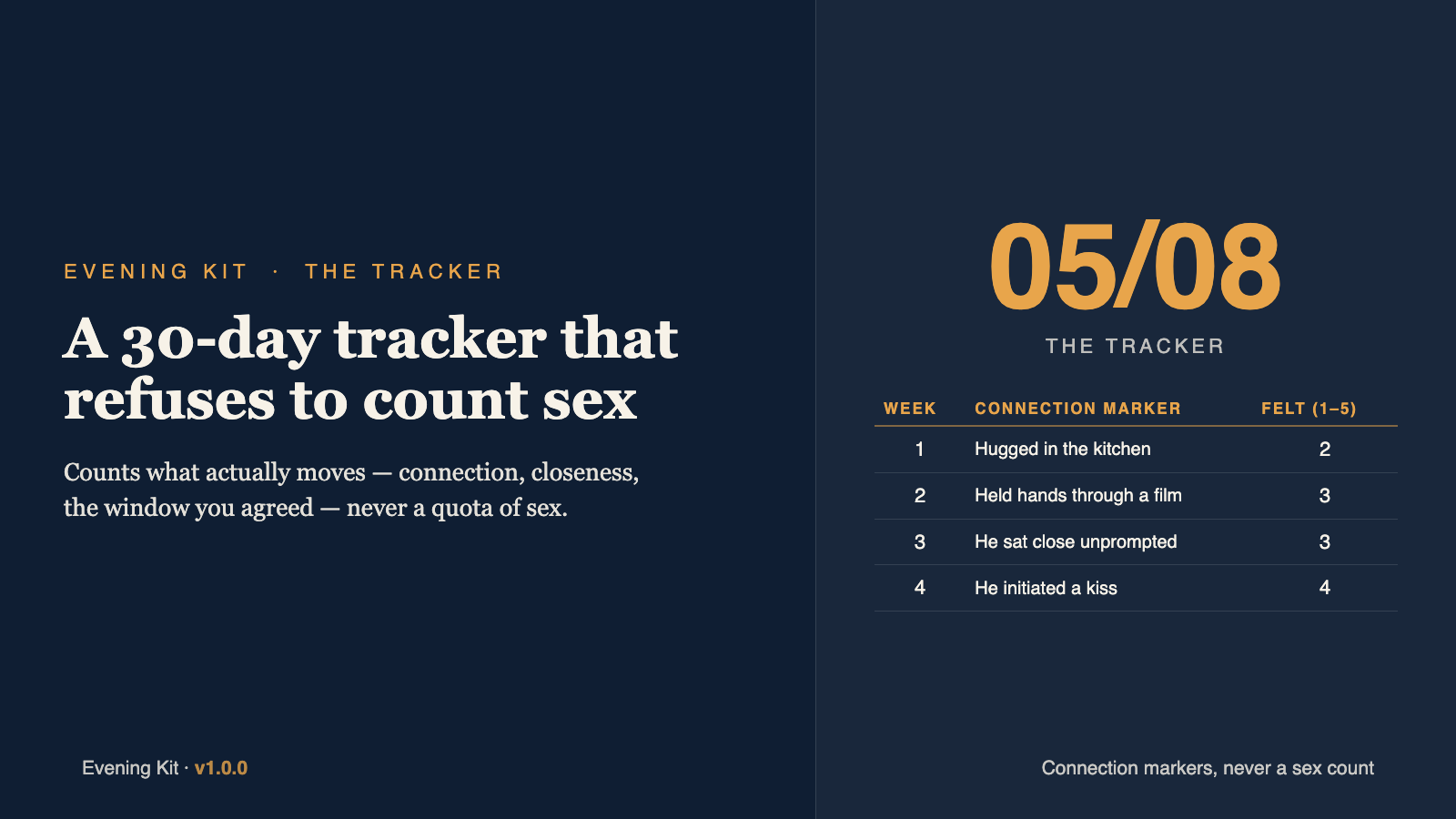
- A tracker that counts connection, never a quota of sex.
What to do tonight, and the 30 days after
TL;DR
- Prepare the opener like a skill: write before you speak, open on connection and hurt, never on frequency.
- The three sentences never to say, crossed out on the card before you start.
- Weeks 1–2: five moves you run from your side only.
- Weeks 3–4: touch without agenda, then a partnered arc, derived not prescribed.
- The weekly check-in counts connection and satisfaction, never a quota.
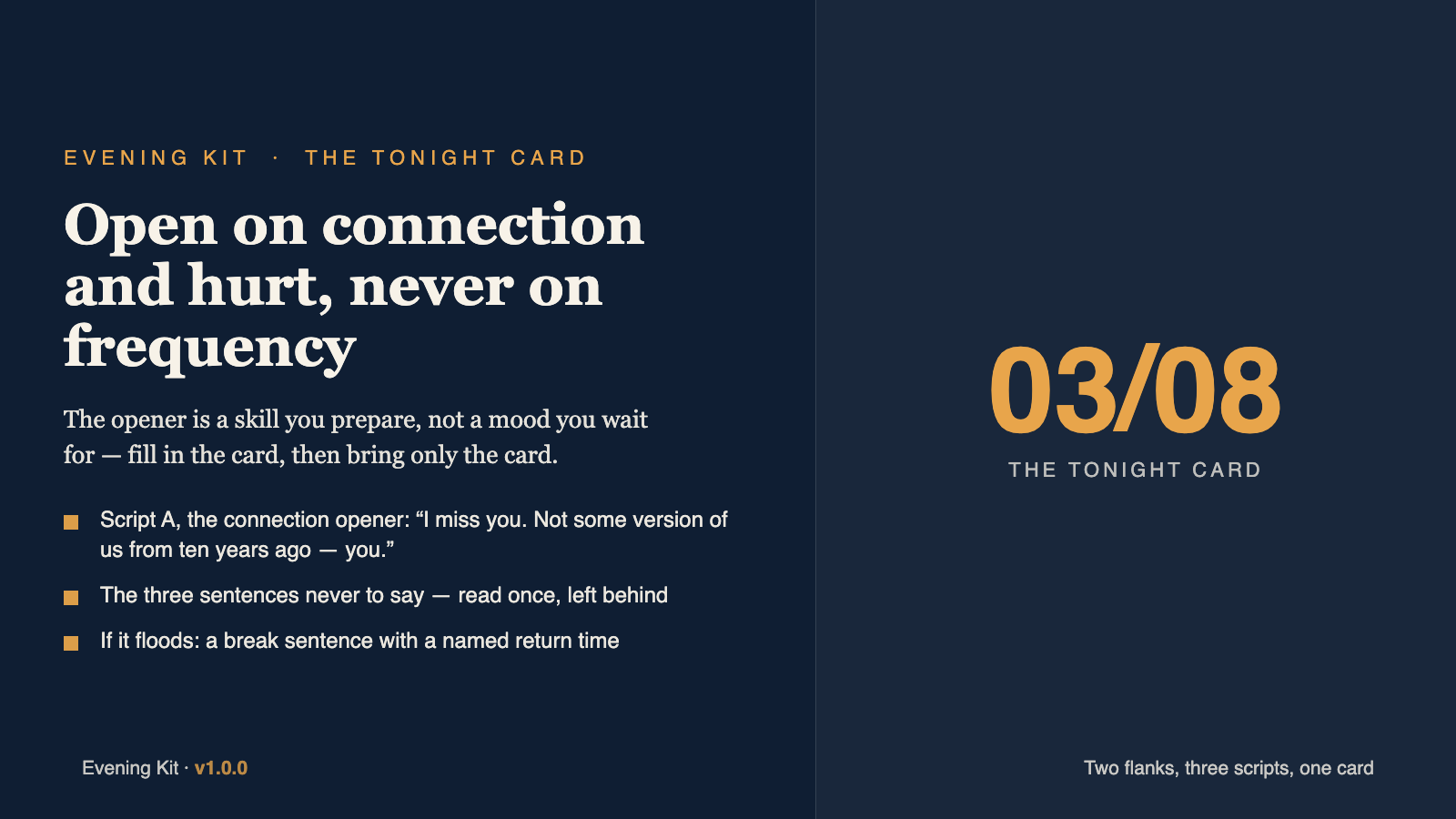
- Prepare, don't improvise. Initiating the talk is a trained skill. AASECT itself runs CE training on it because sex "remains one of the most elusive topics in psychotherapy", and a structured five-week online protocol measurably improved sexual communication. So tonight: write the opener before you speak.
- Open on connection and hurt, never on frequency. Frequency-led openers reproduce the loop, as the community reports. What sits underneath is usually touch and closeness (inferred, not measured); open there.
- Cross out the three sentences never to say. The sentence types documented to fail: the prosecution (a log of rejections read aloud, reported in the community, not re-verified) and the diagnosis ("you never…").
- Pick when, where, and the plan B. Not the end of a tired day, not the bed, and agree the break rule in advance, a timed break with a return time.
- Run weeks 1–2 solo. Five moves from your side only: stop keeping score, use your own stress as the lever it is, make the direct vulnerable request, keep the space rule.
- Touch without agenda. The purpose of the hug is the hug. Affection and sex are separable systems.
- Track connection, not sex. The tracker counts what actually moves you (the window you agreed, closeness, the check-in), never a quota. Tracking that becomes prosecution ends initiation (reported on Reddit, not re-verified).
- Know the hand-off line. Sudden change, pain, or medication change routes to a doctor or a sex therapist credentialed by AASECT. It routes; it never treats.
The hard part: no sentence opens an avoidant partner
Writing for therapists, Couples Therapy Inc. is blunt: "Avoidant mates do not open because you found a gentler sentence." A prepared opener starts the conversation; what it opens into is between the two of you, and the kit says so on the card itself.
Questions people actually ask
Why did my husband stop initiating intimacy?
The documented reasons cluster. Chronic stress lowers desire in daily-life studies. Desire in long-term couples is often responsive: it shows up after closeness, not before. And physical or medication factors belong with a doctor. The gap is a named, studied pattern, not a private defect.
What do I actually say to bring it up without a fight?
Open on connection and hurt, never on frequency. Prepare it: pick the time, write your opener, cross out the three sentences never to say, and agree a timed break with a return time as the plan B.
Can I start alone if my partner won't engage?
Yes. The solo start is the documented starting point: interruption moves run from one side first, and one partner's steps shifting the dance is described in the clinical literature. The partnered half is named as the line the kit does not cross alone.
Is this a subscription?
No. The kit is a one-time $29 purchase, printable tonight, with no recurring charge. For comparison, the anchor book is $13.99 on Kindle, the program is $249/$99/$79, and Gottman's journal is $30.00.
What does the kit NOT cover?
Named in file 09. It does not diagnose or treat; it does not promise an outcome; it does not replace a doctor or a sex therapist credentialed by AASECT. And the exact wording of your opener is yours to write: the kit gives the structure, the ground rules and the three sentences never to say.
Price, and what this doesn't cover
One-time purchase. No subscription, no recurring charge.
He Stopped Initiating: The 'Bring It Up Tonight' Kit. The tonight card, the solo weeks, the partnered weeks, the tracker, the hand-off line named. One evening, $29 once.
Sources (dated, checked 2026-09-11/12)
- AASECT CE training on initiating conversations about sex: aasect.org via Wayback (2025-11-13 snapshot)
- OurRelationship pricing $249/$99/$79, solo completion sold: ourrelationship.com (page modified 2026-08-10)
- Google autocomplete, "my husband stopped initiating intimacy" among completions: suggestqueries.google.com (live 2026-09-11)
- Bing autocomplete second engine: api.bing.com (live 2026-09-11)
- The Sex-Starved Marriage, $13.99 Kindle / 4.3★ / 864 ratings; 1★ theme quoted: amazon.com (live 2026-09-11)
- Pooled FSD 47.81% (95% CI 39.19–56.43, 20 studies): doi.org/10.1186/s12905-025-03960-4 (2025-09-29)
- HSDD "one of the most common female sexual dysfunctions" (ICSM 2024 consensus): doi.org/10.1093/sxmrev/qeaf057 (2025-10-15)
- Daily stress and desire, bidirectional: doi.org/10.1093/abm/kaaf007 (2025-01)
- Five-week online protocol improved communication, 42 couples: doi.org/10.1080/14681994.2025.2506090 (2025-06-03)
- Affection and sex as separable systems (N=336): doi.org/10.1007/s10508-024-03016-y (2024-10-15)
- Self-esteem and sexual satisfaction, 12-wave N>11,000: doi.org/10.1177/01461672241257355 (2024-09-18)
- ICSM 2024, testosterone's primary role in male desire: doi.org/10.1093/sxmrev/qeaf025 (2025-06-06)
- Five interruption moves; solo start shifts the dance: anniewright.com (2026-04-13)
- Five softened-startup scripts, ground rules, red flags: ankenyfamilycounseling.com (2026-09-07)
- Avoidant pattern; "practice outside the bedroom first" is Bisbey via Gottman: couplestherapyinc.com (2025-01-22, updated 2026-08-28)
- "Fifth talk this year" (Reddit via Wayback, reported only): reddit.com/r/DeadBedrooms (2024-12-19)
- Tracking-as-prosecution (Reddit via Wayback, reported only): reddit.com/r/DeadBedrooms (2024-12-30)
- Gottman 30-day journal $30.00: gottman.com (modified 2026-03-19)
- Rullo framework on mismatched drives: gottman.com (2025-12-09)
- Pursuer-distancer named: gottman.com (2020-02-22)
- Gottman Card Decks free app: apps.apple.com (ver. 2026-06-15)
- Sensate focus, public structure: en.wikipedia.org/wiki/Sensate_focus (live)
- Paired app 4.73★ / 207,000+ ratings (as of 2026-09-12), free + subscription inside: itunes.apple.com (ver. 2026-09-09)
- Evergreen app 4.82★ / 54,000+ ratings (as of 2026-09-12): itunes.apple.com (ver. 2026-09-05)
- Dead Bedroom Reset, scripts, zero ratings: amazon.com (2026 title)
- "Rarely a final verdict"; sexless-marriage repair framing: gottman.com (2025-10-16)
- Bisbey, "Practice your communication skills on challenging topics outside the bedroom first": gottman.com (live)