Questions to Ask Your Doctor About Finasteride: The Full List
Why arriving with a chosen list matters
The freeze does not always happen before the appointment. A 31-year-old with a dermatologist's own diagnosis of androgenetic alopecia had already taken the hardest step: he booked the visit, sat in the chair, and had a name for what was happening to his scalp. His dermatologist recommended ketoconazole shampoo, salicylic shampoo and minoxidil foam, and raised finasteride. He declined it. Not because a study told him to, and not because his prescriber advised against it, but because, in his own words, he "didn't have enough time to research it" before the visit (Tressless community forum, published 2026-06-29). Two months later he was still researching alone, listing the same fears this page answers with sources: post-finasteride syndrome, sexual side effects while planning a family, mood, and oral minoxidil's blood-pressure effects.
"It felt like the decision was mostly up to me." Same thread, describing the appointment's own aftertaste.
The diagnosis was already made. The prescription was already offered. What was missing was a written, chosen list of questions, so the deciding, and the researching, could happen with the prescriber in the room instead of alone afterward. That is the gap this page closes: the twelve question sections below, given in full, with the source behind every one.
TL;DR
- Twelve sourced sections: type, stage, the frequency table, the meta-analysis disagreement, mood, post-finasteride syndrome, the options (minoxidil, oral minoxidil, dutasteride), the shelf (ketoconazole, PRP, supplements), duration, fertility, self-dosing, who-should-not, and follow-up.
- A short appointment carries four to six; a branch table below tells you which, by your situation.
- Every question traces to the US label, the UK SmPC, the NHS, or a named published study, quoted with its date.
- No dose, no treatment and no diagnosis is recommended anywhere on this page; every intervention point converts to a question for your own prescriber.
- What's free is the list. What's paid is the fillable annex, printed as a script, and the dated 90-day photo register that shows what happened after you asked.
The twelve prescriber questions, in full
These are written out exactly as they exist inside The Early Thinning Action Plan's appointment script, because the position here is not to withhold the questions and sell the reveal. It is to hand you the finished list and let the fillable annex, and the dated register that shows what happened after you asked, be the part that's paid. Bring a pen; the answer column is where the value shows up.
Which four to six you bring depends on your situation
| Your situation | Bring these sections |
|---|---|
| Prescription in hand, unstarted | 1 (type), 2 (stage), 3 (frequency table), 4 (mood), 12 (follow-up); add 8 (duration) if the forever question is yours |
| One click from checkout | 1 (type), 3 (frequency table), 6 (options), 8 (duration); add 2 (stage) if no clinician has staged you yet |
| Already started, unsure or self-adjusting | 10 (dose), 4 (mood), 12 (follow-up); add 11 (who should not) if anything on that list is yours |
| Declined in the chair, or stopped and thinking of restarting | 8 (duration and restart), 2 (stage), 12 (follow-up); add 9 (fertility) if children are planned |
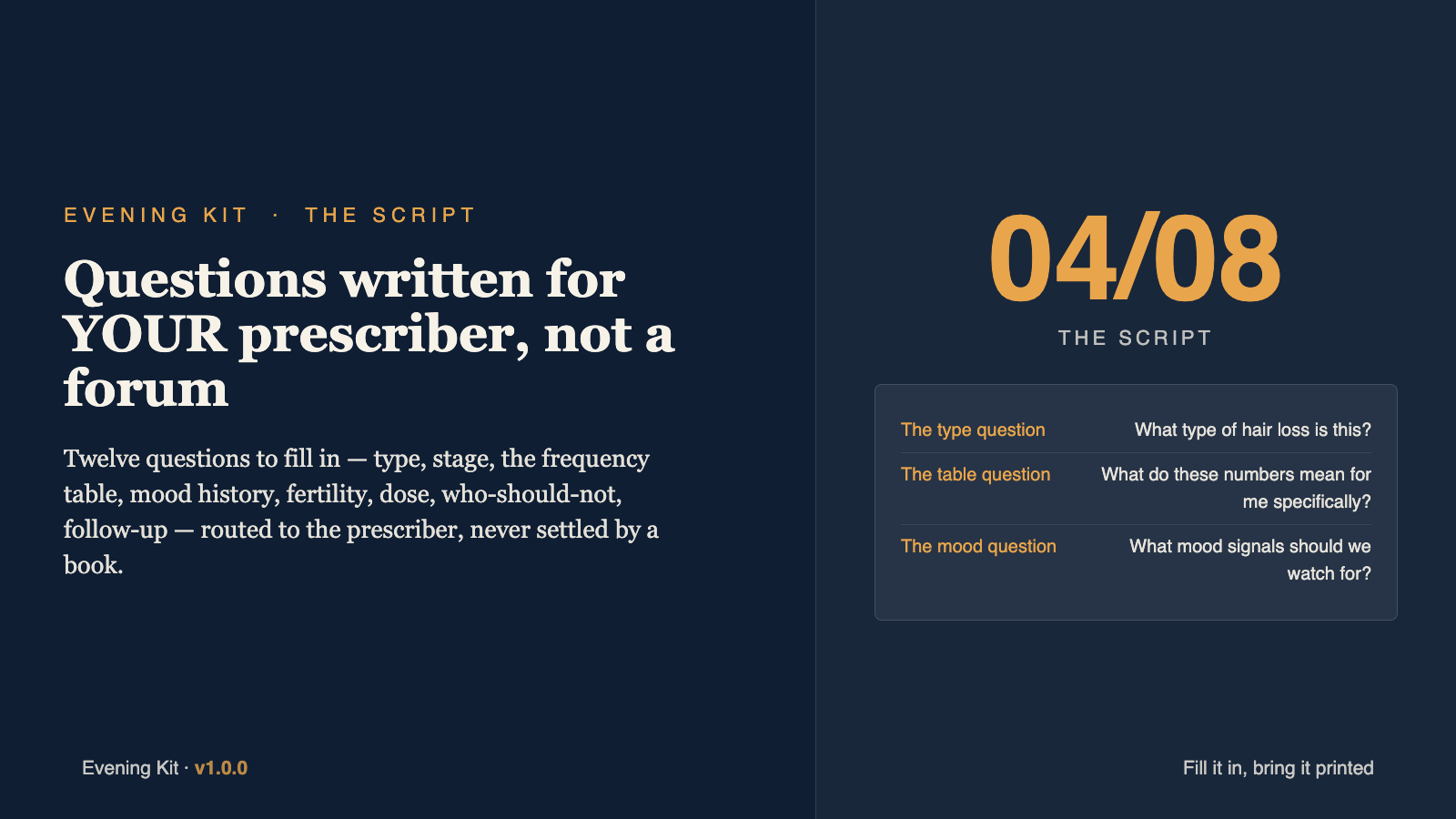
- 1 · The type question. "What type of hair loss is this?" and "Could this be areata, a scarring alopecia, or telogen effluvium rather than pattern loss?" A dermatologist can tell what type you have and what results to expect (American Academy of Dermatology, patient page); different diagnoses need different responses, and delaying evaluation risks progression (Ubie Health, Doctor's Note, 2025-12-04).
- 2 · The stage question. "At my stage, what results should I realistically expect?" and "Can you do trichoscopy, or measure my diameter variation, and what does it show?" Results depend on stage, and men tend to do better starting soon after noticing (AAD). A hair-shaft thickness diversity of 20% or more, measured against the occipital donor area, is treated as diagnostic of androgenetic alopecia (DermNet, dated 2023-03-06; myhairline.ai, 2026-07-11), and the threshold is still under active debate in the dermatology literature (JAAD letter exchange, 2025-07-03 through 2026), which is exactly why it belongs to the person holding the dermatoscope, not to a self-check.
- 3 · The frequency-table question. "The label's Year-1 table shows decreased libido 1.8% versus 1.3% on placebo, and 3.8% of treated men reporting one or more sexual side effect. What do these numbers mean for me specifically?" That table comes from the US label (DailyMed, effective 2024-10-14) and the UK SmPC (EMC, revised 2026-03-07), which carries the same numbers and adds that by year five each figure had dropped under 0.3%. A second question belongs beside it: "The published meta-analyses disagree, one puts pooled risk at 1.57, another at 1.21 and not statistically significant, a third finds active treatments no different from placebo. How should I read that disagreement for my decision?" Three independent journal meta-analyses reach three different readings of the same drug class (Acta Dermato-Venereologica, 2019; Journal of Sexual Medicine, 2016-09; Journal of Dermatological Treatment, 2014-04).
- 4 · The mood question. "What mood signals should I, and the people around me, watch for?" The UK SmPC carries a mood-alteration warning with a monitoring instruction (EMC, 2026-03-07), and two independent reviews name depression, anxiety and suicidal-risk signals in the published record (Journal of Clinical Psychopharmacology, 2021-05-01; Journal of Clinical Psychiatry, 2025-09-22, an intentionally one-sided argument for the precautionary principle, read beside the label, never alone). A second question follows it. "If low mood shows up, what exactly do I do?" The NHS supplies the sharpest sourced line in this whole script, contact a doctor immediately, stop the medicine, and tell family or friends (NHS, Side effects of finasteride, reviewed 2023-08-02).
- 5 · The PFS question. "A BMJ review discusses post-finasteride syndrome, and other papers report pharmacovigilance signals for it. What is established, and what isn't, in your reading?" A BMJ 2019 clinical review titled "Post-finasteride syndrome" is indexed for MEDLINE, discussing persistent post-discontinuation symptoms without adjudicating causality (BMJ, 2019-08-09); this guide adjudicates neither way either.
- 6 · The options question. "If I use topical minoxidil, what does the 5% versus 2% and irritation data mean for me?" A 48-week trial of 393 men found 5% superior on hair count but with more pruritus and irritation than 2% (JAAD, 2002-09). "Is oral minoxidil an option at my stage, and what should be monitored?" The first comparative RCT of oral versus topical minoxidil for male pattern loss ran 24 weeks, with its own stated limits (JAMA Dermatology, 2024-06-01). "Can't I just use minoxidil and skip the pill, what would I be trading?" A hair-restoration surgeon calls that "a valid and important question" (Dr Rana Irfan, 2025-07-10); a UK clinic frames the answer as depending on why you're using either agent (Wimpole Clinic, 2025-03-07); a 2025 meta-analysis of seven RCTs quantifies what the combination adds over minoxidil alone (Frontiers in Medicine, 2025). "Does the dutasteride evidence apply to me, and who funded the trial?" That trial's dose-response basis lists GlaxoSmithKline Research and Development among the disclosed author affiliations (JAAD, 2014-03).
- 7 · The shelf question. "Which of the things I already bought, ketoconazole shampoo, saw palmetto, supplements, a laser cap, have evidence worth their place?" A Canadian Delphi consensus of eleven physicians reviewed 45 interventions and published what is recommended, near-consensus, and explicitly not recommended, including rosemary oil and caffeine (Journal of Cutaneous Medicine and Surgery, 2025-09-23).
- 8 · The duration question. "If I start, am I committing for life? What happens if I stop?" Continued use is recommended to sustain benefit, and if treatment is stopped, effects begin to reverse by 6 months and return to baseline by 9 to 12 months (UK SmPC, 2026-03-07). The NHS treats long-term use as ordinary, noting many people take it for months or years (NHS, Common questions about finasteride, reviewed 2023-08-02). "What would restart look like if I ever stopped and changed my mind?" Restart accounts online are individual reports, not data. Your prescriber's version is the one that counts.
- 9 · The fertility question. "We're planning children. What do the sperm-count findings mean for us?" A 2026 narrative review synthesises reported reductions in sperm count across the studies it reviewed and calls for more research in younger men (Reproductive Toxicology, 2026-08-01); both labels list infertility and poor seminal quality as postmarketing reports, with normalisation after discontinuation noted (US label, 2024-10-14; UK SmPC, 2026-03-07).
- 10 · The dose question, if you've been experimenting. "I've been taking 0.25 mg daily, or every other day, or a cut 5 mg pill, or three days a week, instead of the prescription. How do we find the right dose for me?" Self-directed sub-prescription dosing is a documented pattern across multiple community threads from 2025 into 2026, quartered pills, invented weekly schedules, and doses cross-checked with an AI chatbot rather than a prescriber. It is a failure mode this guide converts into one question, never a regimen.
- 11 · The who-should-not question. "Given my history, allergy, depression history, bladder, liver, other medicines, is there anything on the label's tell-your-doctor list that changes the plan?" The NHS tell-your-doctor list (reviewed 2023-08-02) and the SmPC's contraindications and PSA and breast-tissue warnings (EMC, 2026-03-07) cover it.
- 12 · The follow-up question. "Can we book the follow-up at 90 days, and will you look at my photo register, taken at fixed conditions?" Standardized photography is the trial-grade measurement method (JAAD, 1998; a 2026-updated photo-methodology commentary), and the official stabilisation window is three to six months (UK SmPC; NHS).
The hard part: a short appointment, not twelve sections
Primary-care and telehealth visits run short, and the script above says so on its own: a focused appointment carries four to six of the twelve sections, not all of them. Walking in undecided about which ones matter is its own failure mode, and it is the one documented at the top of this page. A 31-year-old already diagnosed with androgenetic alopecia, whose own dermatologist had raised finasteride in the room, still declined it, not from a verdict on the drug, but because he hadn't had time to research it before the appointment started. Two months later he was still researching alone, and the visit itself, he said, felt like the decision was mostly up to him. The diagnosis was already made. The prescription was already offered. What was missing was a chosen, written set of questions, ready before the door opened, whatever short window his clinic runs. Use the branch table above to cut the twelve to your four to six before you book; underlining and deleting on paper beats composing questions out loud in the room.
Questions men actually ask
Do I need to ask all twelve sections?
No. The script itself says a focused visit carries four to six of the twelve, chosen by your situation: prescription in hand and unstarted, one click from checkout, already started, or declined before. Pick before you book, using the branch table above.
Will these actually get answered in a short appointment?
Each question extracts a fact already published: the label's own frequency table, the SmPC's mood warning, the NHS's tell-your-doctor list. A prescriber is answering with reference points that exist, not opening new research. That is different from asking for a personal guarantee, which no source in this guide prints.
What if my prescriber doesn't offer trichoscopy?
Then that answer belongs on the page too. Write down what they say instead, and whether a referral exists, and bring the note to the next visit. The point is a written record either way, not one specific instrument.
I already had the appointment and left with nothing decided. Now what?
That happened to the buyer quoted above: he declined the finasteride his dermatologist raised because he hadn't had time to research it, and two months later was still researching alone. The fix is the same for a second appointment as a first: choose four to six sections, fill the answers column, and book the follow-up before you leave.
Does this page or the guide replace medical advice?
No. It organises questions and preparation; it does not diagnose, prescribe or promise a result. Every intervention point here is written as a question for your own prescriber.
Price, and what this doesn't cover
One-time purchase. No subscription, no recurring charge.
The Early Thinning Action Plan: the twelve-section script as a fillable printable annex, the frequency table with placebo columns, staging worksheet, and the dated 90-day register that shows what happened after your appointment. One evening to prepare, 90 days to be sure. $29 once.
Sources (dated, checked 2026-09-11/17)
- The consult that survived a diagnosis and stalled anyway: community.tressless.com, thread published 2026-06-29
- Type and diagnosis-first: American Academy of Dermatology, aad.org (undated, attribution only); Ubie Health, ubiehealth.com (2025-12-04)
- Trichoscopy / staging: dermnetnz.org (2023-03-06); myhairline.ai (2026-07-11); JAAD letter exchange, pubmed.ncbi.nlm.nih.gov/40617541 (2025-07-03, letters through 2026)
- US label: dailymed.nlm.nih.gov (2024-10-14). UK SmPC: medicines.org.uk/emc (revised 2026-03-07)
- Meta-analyses read as one table: pubmed.ncbi.nlm.nih.gov/30206635 (2019); pubmed.ncbi.nlm.nih.gov/27475241 (2016-09); pubmed.ncbi.nlm.nih.gov/23768246 (2014-04)
- Mood and PFS: pubmed.ncbi.nlm.nih.gov/31399423 (BMJ, 2019-08-09); pubmed.ncbi.nlm.nih.gov/33814544 (2021-05-01); pubmed.ncbi.nlm.nih.gov/41004169 (2025-09-22)
- NHS mood-action instruction and tell-your-doctor list: nhs.uk/side-effects and nhs.uk/who-can-and-cannot-take (both reviewed 2023-08-02); duration answer: nhs.uk/common-questions (reviewed 2023-08-02)
- Minoxidil and dutasteride evidence rows: pubmed.ncbi.nlm.nih.gov/12196747 (2002-09); pubmed.ncbi.nlm.nih.gov/38598226 (2024-06-01); pubmed.ncbi.nlm.nih.gov/24411083 (2014-03); drranairfan.com (2025-07-10); wimpole.com (2025-03-07); combination meta-analysis pubmed.ncbi.nlm.nih.gov/41127390 (2025)
- The shelf, Canadian consensus: pubmed.ncbi.nlm.nih.gov/40986632 (2025-09-23)
- Fertility: pubmed.ncbi.nlm.nih.gov/42069234 (2026-08-01)
- Photo methodology: perfecthairhealth.com (2026-03); pivotal trial standardized photography, pubmed.ncbi.nlm.nih.gov/9777765 (1998)
- Self-dosing workaround voices (documented failure modes, never a regimen): r/tressless threads, quoted from public forums, individual accounts not data; community.tressless.com threads published 2025-07-09 and 2025-08-10; hairlosstalk.com thread published 2026-02-13