Scared to Take Finasteride? Read the Numbers Both Ways First
The freeze, in your own words
The thread titles say who this page is for. One of them is the whole problem in five words, "Bought Finasteride but too scared to take it". Another: "I'm too scared to take it because of the side effects", after five months of holding the bottle. A third held it five months and started on a quarter of his prescribed dose, on his own, out of fear. And one man did all of this and still declined at the dermatologist's chair: "declined finasteride because I didn't have enough time to research it".
"I've had hims with finasteride for like 5 months now." and "I'm too scared to take it because of the side effects", reported on a public forum, not re-verified
What the freeze costs is not courage; it is the missing denominators. One community reply explains why: "responses that sit outside a couple standard deviations from the mean will be overrepresented"; the internet shows you the extremes, by construction. And Tressless's own beginner guide concedes the free layer's failure: "a ton of information" where "it can be difficult to figure out what products you truly need".
What staying frozen already costs
| Route tried instead of deciding | Documented cost | What it settles |
|---|---|---|
| The textbook route | $36.95, 4.7★/66, whose own reviewer writes "more text book than the common individual is looking for" | Pharmacology, not your decision |
| The cheap $11.99 guide | 2.0★ from 2 ratings; its 1★ review: "fake, removes hair... This is a book... insta trashed" | Nothing that survived contact |
| The subscription route | Telehealth plans marketed with "Regrow hair in as fast as 3 months", seller marketing, not a trial endpoint | A delivery channel, not a decision |
Prices scan-observed 2026-09-11 and cited with their scan date, not re-rendered live. The freeze's real invoice is not money. Miniaturisation is progressive, month by month.
"I'm so pissed I didn't start finasteride sooner" and "Now I have to look at transplants", reported on Reddit, not re-verified
The surgical endpoint has a price: a UK clinic's first-party all-inclusive range is GBP 3,500–7,500, with candidacy rules that not everyone meets. No number on this page predicts your case. They are the documented alternatives to deciding.
What you hold at the end of one evening
- Your stage placed on the miniaturisation timeline: the measurable version of "is it too late".
- The Year-1 frequency table read WITH its placebo columns: your number, not a story.
- The three disagreeing meta-analyses read as one table.
- Twelve questions written for YOUR prescriber, filled in and ready to bring.
- Day-0 photos taken at fixed conditions, starting a dated 90-day register.
The numbers, both ways, in order
TL;DR
- Year-1 label table: decreased libido 1.8% vs 1.3% placebo; erectile dysfunction 1.3% vs 0.7%; 3.8% of 945 treated men reported one or more. UK text: same table, <0.3% by year five.
- Three meta-analyses disagree: 1.57 (1.19–2.08) vs 1.21 (0.85–1.72), not significant, vs no difference.
- Mood: the BMJ review discusses post-finasteride syndrome; the 2021 systematic review's observations exist; the NHS instruction on low mood is quoted, not softened.
- Dose fear is a prescriber conversation, not a forum strategy.
- Then decide dated: prescriber questions filled, day-0 photos taken.
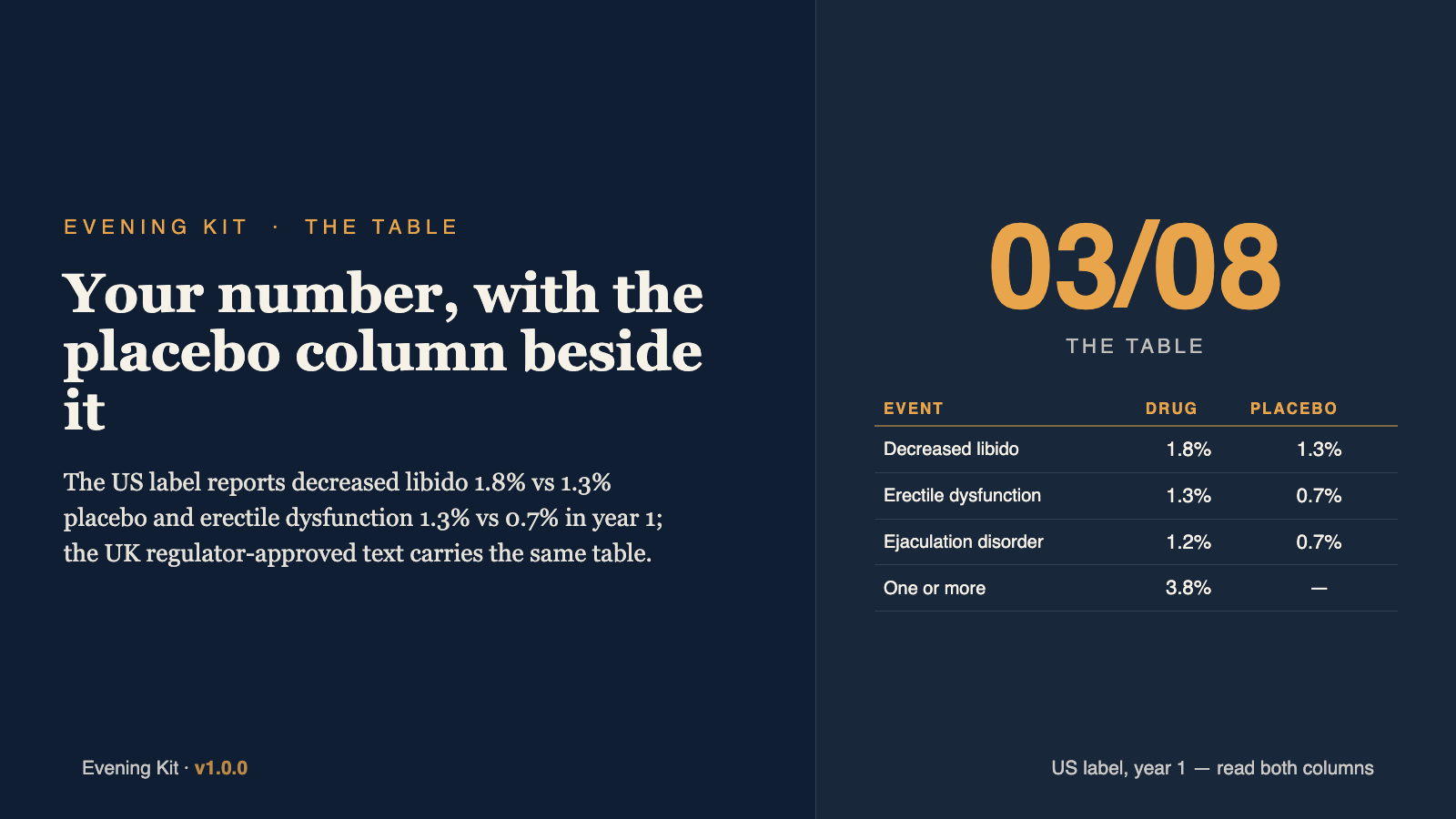
- Read the label table with its placebo columns. The US label (945 finasteride vs 934 placebo, year 1): decreased libido 1.8% vs 1.3%, erectile dysfunction 1.3% vs 0.7%, ejaculation disorder 1.2% vs 0.7%, 3.8% reported one or more. The UK regulator-approved text (the SmPC) carries the same table and adds that by year five each fell below 0.3%. NHS category language beside it: common means more than 1 in 100; serious side effects are rare, less than 1 in 1,000.
- Read the three meta-analyses as one table. 1.57 (95% CI 1.19–2.08); 1.21 (95% CI 0.85–1.72), not statistically significant, in hair-loss populations; a third found active treatments not significantly different from placebo on global sexual dysfunction. The guide teaches reading that disagreement (placebo subtraction, confidence intervals, the selection-bias frame) and picks no side.
- Map the mood question both ways. The BMJ 2019 review titled "Post-finasteride syndrome" is discussed in the mainstream literature; the 2021 systematic review reports emerging observations of depression and anxiety; the NHS says common effects "usually improve after a while, but they can sometimes carry on even after you stop". Nothing here adjudicates causality in either direction.
- Convert dose fear into a prescriber question. The forum workarounds are documented (0.25 mg daily, quartered 5 mg pills, invented Monday-Wednesday-Friday schedules, microdose ramps, one case checked with a chatbot). Each is a failure mode in the record, and each becomes a question on your script.
- Decide dated, not frozen. Fill the twelve-question prescriber script, take day-0 photos at fixed conditions, and start the 90-day register: the decision process with an anchor and a measurement.
The hard part: this page cannot tell you whether to start
No table settles your decision. The 3.8% row is a Year-1 label statistic across 945 men, not a forecast for you; the 1.57 finding pooled heterogeneous studies and the 1.21 one did not reach significance, and the disagreement itself is the honest finding. What the page can do is replace a horror story with the numbers and a written question list for the one person who can act on them: your prescriber. If you develop low mood while taking any medicine, the NHS instruction is to contact a doctor immediately and stop the medicine.
Questions men actually ask
How common are finasteride's sexual side effects, really?
Year-1 US label, 945 treated vs 934 placebo: decreased libido 1.8% vs 1.3%, erectile dysfunction 1.3% vs 0.7%, 3.8% reported one or more; UK text same table, <0.3% by year five; NHS categories: common >1 in 100, serious rare <1 in 1,000.
Do the studies disagree?
Yes: 1.57 (95% CI 1.19–2.08); 1.21 (95% CI 0.85–1.72), not statistically significant; a third found no significant difference from placebo. The guide teaches reading the disagreement instead of resolving it by comfort.
Is post-finasteride syndrome real?
The BMJ 2019 review discusses it as a named topic; the 2021 systematic review reports observations; the NHS phrasing is "can sometimes carry on even after you stop". This page adjudicates nothing, in either direction.
Should I cut the pill or take a lower dose?
That is a prescriber question. The self-dosing forms in the record (0.25 mg, quartered pills, MWF, microdose ramps, one chatbot-checked plan) are documented failure modes, not regimens.
What does the guide NOT cover?
It does not diagnose, prescribe or treat; it names no guarantee; it never tells you what to take. A guide for advanced loss, or for scarred or patchy patterns, is a dermatologist conversation first.
Price, and what this doesn't cover
One-time purchase. No subscription, no recurring charge.
The Early Thinning Action Plan: the numbers both ways, the prescriber script, the dated 90-day register. One evening to decide, 90 days to be sure. $29 once.
Sources (dated, checked 2026-09-11/12)
- US FDA label, finasteride 1 mg, Year-1 adverse-event table: dailymed.nlm.nih.gov (label effective 2024-10-14)
- UK SmPC, finasteride 1 mg: medicines.org.uk/emc (revised 2026-03-07)
- NHS, side effects of finasteride: nhs.uk (page reviewed 2023-08)
- Meta-analysis, pooled sexual-dysfunction risk: pubmed.ncbi.nlm.nih.gov/30206635 (2019)
- Meta-analysis, hair-loss vs prostate populations: pubmed.ncbi.nlm.nih.gov/27475241 (2016)
- Meta-analysis, active treatments vs placebo: pubmed.ncbi.nlm.nih.gov/23768246 (2014)
- BMJ, "Post-finasteride syndrome": pubmed.ncbi.nlm.nih.gov/31399423 (2019)
- Systematic review, mood observations: pubmed.ncbi.nlm.nih.gov/33814544 (2021)
- NHS, who can and cannot take finasteride: nhs.uk (2023-08)
- Miniaturisation explained: balding.app (2026-04); Traya, medically reviewed traya.health (2026-01)
- Trichoscopy, ≥20% diversity diagnostic: dermnetnz.org (2023-03); myhairline.ai myhairline.ai (2026-07)
- Transplant cost, first-party GBP range: wimpole.com (2025-11, upd. 2026-07); candidacy wimpole.com
- Shelf observations: Gomez textbook amazon.com; Kleinfeld guide amazon.com; Keeps marketing lines keeps.com; 31M freeze after the consult community.tressless.com
- Tressless official beginner guide (the free layer's own words): community.tressless.com
- Buyer voices, individual accounts not data: quoted from public forum threads; each resolves in the guide's sources file to thread, date and archive status