Finasteride Side Effects: How Common Are They, Really?
What "how common" is actually asking
Every man who types this question already knows the answer isn't zero and isn't everyone; what he's actually asking is for a number with a denominator, and the internet almost never gives him one. On the largest hair-loss forum, one poster frames his own odds like this, "stuck between wanting to take finasteride to preserve my hair" and not wanting the risk, asking strangers for "stories of people that have had good or bad experiences", reported on a public forum, not re-verified. The folklore version of "how common" circulating in that same community rounds to a flat 2%, a number that does not appear on the FDA label, the UK regulator-approved text, or in any of the three meta-analyses in the published record.
Another thread on the same forum names the mechanism behind that gap directly. "Responses that sit outside a couple standard deviations from the mean will be overrepresented", reported on a public forum, not re-verified. The men who post are disproportionately the ones with a story to tell, in either direction; the men whose experience was mundane don't write a thread about it. That single sentence, from inside the community itself, is the most honest explanation available for why "how common" feels unanswerable from browsing alone.
What guessing at the number already costs
| Route tried instead of the real number | Documented cost | What it settles |
|---|---|---|
| Trusting the forum's "2%" folklore | No denominator is ever given in the thread that repeats it; the label's own decimal table shows 1.8% vs 1.3% placebo, a 0.5-point difference on that row, not 2% | Nothing; folklore is not the label |
| The $36.95 textbook route | 4.7 stars from 66 ratings, whose own reviewer writes "more text book than the common individual is looking for" | Pharmacology depth, not a one-sitting frequency answer |
| The subscription marketing route | Telehealth plans advertised with "Regrow hair in as fast as 3 months", seller marketing, not an adverse-event frequency | A delivery channel, not a percentage |
Prices scan-observed 2026-09-11 and cited with their scan date, not re-rendered live. Guessing wrong runs both directions: overestimating the odds freezes the decision for months, while underestimating them means a real symptom gets waved off as "probably nothing" instead of the prescriber call the NHS actually instructs.
The overestimating direction is well documented. "Thanks to the fear mongoring i was scared and postponed it", reported on a public forum, not re-verified, is one man's account of a delay he attributes directly to the information environment, not the drug. The underestimating direction has a stated cost too: the NHS instruction for hair-loss patients who develop low mood is to contact a doctor immediately and stop the medicine, not to wait and see if it passes, and a buyer who arrived believing "basically nothing happens" has no trigger for that call built in.
What you hold at the end of one evening
- The Year-1 frequency table read WITH its placebo columns, the denominator forums never give you.
- The NHS's category language (common, rare) mapped onto those same percentages, so "how common" has two registers, not one.
- The three disagreeing meta-analyses read as one table, so the question outside the label also gets an honest answer.
- Twelve questions written for YOUR prescriber, including which of these rows apply to your own history.
- Day-0 photos taken at fixed conditions, starting a dated 90-day register.
The full Year-1 table, placebo column included
TL;DR
- Label Year 1 (945 vs 934 placebo): decreased libido 1.8% vs 1.3%; erectile dysfunction 1.3% vs 0.7%; ejaculation disorder 1.2% vs 0.7%; 3.8% reported one or more vs 2.1% placebo.
- By year five, each of those rows falls below 0.3% per the UK text.
- All-cause discontinuation was actually higher on placebo (2.1%) than on drug (1.7%); sexual-AE-specific discontinuation ran the other way (1.2% vs 0.9%).
- Outside the label, three meta-analyses disagree: 1.57 (1.19 to 2.08) vs 1.21 (0.85 to 1.72, not significant) vs no significant difference.
- Mood: two reviews report an association with depression and anxiety; causality is adjudicated nowhere on this page.
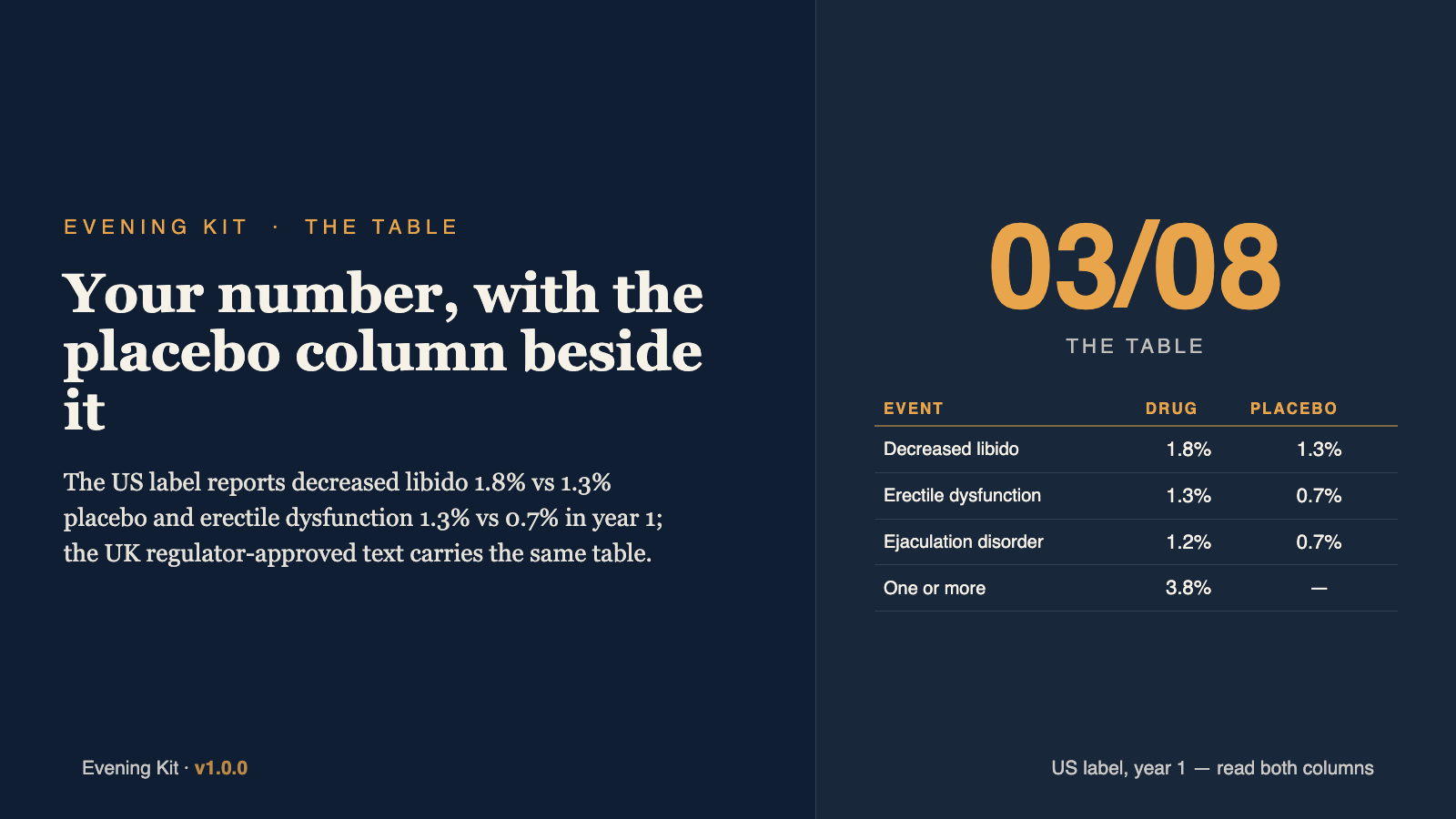
- Start with the denominator. The pivotal US trial data behind the label ran on 945 men taking finasteride 1 mg and 934 on an inactive placebo pill, tracked across Year 1. Every percentage below is out of those numbers, not out of "people online".
- Read the table row by row, with its placebo column. This is the exact table the folklore "2%" never shows.
| Adverse effect, Year 1 | Finasteride 1 mg (N=945) | Placebo (N=934) | Source |
|---|---|---|---|
| Decreased libido | 1.8% | 1.3% | US label; UK SmPC |
| Erectile dysfunction | 1.3% | 0.7% | US label; UK SmPC |
| Ejaculation disorder (decreased ejaculate volume) | 1.2% (0.8%) | 0.7% (0.4%) | US label |
| Any drug-related sexual adverse effect, one or more | 3.8% (36 of 945 men) | 2.1% | UK SmPC; the US label states the 3.8% figure without a placebo column on that specific line |
| Discontinued due to drug-related sexual adverse effects | 1.2% | 0.9% | US label |
| Discontinued due to any clinical adverse effect (all causes, not sexual-specific) | 1.7% | 2.1% | UK SmPC |
| Each row above, by year five of continued use | below 0.3% | not stated | UK SmPC |
Read that all-cause discontinuation row again. The placebo group actually stopped treatment slightly more often (2.1%) than the finasteride group (1.7%). That is a real number from the same regulator-approved text, and it cuts against the "everyone quits from side effects" version of the story, the same way the sexual-AE-specific discontinuation row (1.2% vs 0.9%) cuts against "nothing happens." Both rows are true at once; that is what reading a table with its placebo column actually gets you.
- Translate the percentages into the other official vocabulary. The NHS frames the same events in patient-facing categories rather than decimals. Common side effects happen in more than 1 in 100 people; serious side effects are rare, less than 1 in 1,000; and common effects "usually improve after a while, but they can sometimes carry on even after you stop taking finasteride." Decimal and category are two honest ways of saying the same thing, and the guide teaches keeping both, never merging them into one invented figure.
- Read the three disagreeing meta-analyses as one table. Outside the label, the published literature on sexual dysfunction in hair-loss populations does not converge on a single number either. A 2019 meta-analysis of 15 randomized trials (4,495 subjects) reports a pooled risk ratio of 1.57 (95% confidence interval 1.19 to 2.08). A 2016 meta-analysis reports 1.21 (95% CI 0.85 to 1.72) in hair-loss populations specifically, a result that does not reach statistical significance. A 2014 network meta-analysis found active treatments not significantly different from placebo on global sexual dysfunction. The guide teaches reading that disagreement, not resolving it by comfort or by picking whichever number is easiest to live with.
- Map the mood question, both ways, with no percentage attached. Unlike the sexual-effect rows, there is no equivalent frequency table for mood in the corpus, because none exists in the same form. A 2021 systematic review in the Journal of Clinical Psychopharmacology states that emerging clinical observations indicate finasteride treatment may be associated with depression, anxiety and possibly increased suicidal risk, even after discontinuation. A 2025 analytical review argues that between 2017 and 2023, four independent adverse-event-reporting analyses and four data-mining studies indicated a significant increase in that same risk, and that recognition of the signal took roughly two decades; that review argues one direction deliberately and belongs beside the others, never alone. The UK regulator-approved text warns of mood alterations including depressed mood and, less frequently, suicidal ideation, with an instruction to discontinue and seek medical advice. The NHS instruction is the sharpest, telling patients to contact a doctor immediately if low mood develops, stop the medicine, and tell family or friends the drug may affect mood or behaviour. Nothing here settles whether the drug causes it; the sourced instruction is what to do if it happens.
- Read the two numbers that never make it onto forum threads. A 2026 narrative review synthesizes reports of sperm-count reductions across studies, 34% with finasteride and 29% with dutasteride, a figure from the review's own synthesis of heterogeneous studies, never a population rate, alongside hormonal shifts including raised testosterone and variable sexual-function persistence after stopping. The FDA and UK labels both list infertility and poor seminal quality as postmarketing reports, with normalisation or improvement after discontinuation noted in the UK text. Separately, a 2026 matched-cohort study followed 3,470 men with five or more years of finasteride use against 3,470 matched men with hair loss who never took it, and found the treated group had a higher rate of subsequent ED-medication prescriptions (13.6% vs 10.5%, a statistically significant difference) and received them on average 238.6 days earlier. That is an observational association from a database, not a controlled trial, and it converts into exactly one thing on this page, a question for a prescriber about long-term monitoring, never a conclusion.
- Convert the leftover fear into a prescriber question, then decide dated. The forum record documents four distinct self-dosing workarounds born from side-effect fear (quarter-tablet doses, every-other-day schedules, invented three-day-a-week rotations, one case cross-checked with a chatbot instead of a prescriber); each is a failure mode in the record, never a regimen, and each becomes a written question on the script instead. Fill the twelve-question prescriber script, take day-0 photos at fixed conditions, and start the 90-day register: the decision with an anchor and a measurement, not a guess.
The hard part: no percentage tells you what happens to you
The 3.8% row is a Year-1 label statistic across 945 men, not a forecast for any one of them; the 1.57 finding pooled heterogeneous studies and the 1.21 finding did not reach significance, and the disagreement itself is the honest finding rather than a gap to be filled in with folklore. What this page can do is replace a rounded-off number with the actual table and a written question list for the one person who can weigh it against your own history, your prescriber. If you develop low mood while taking any medicine, the NHS instruction is to contact a doctor immediately and stop the medicine.
Questions men actually ask
How common are finasteride's sexual side effects, really?
Year-1 US label, 945 treated vs 934 placebo: decreased libido 1.8% vs 1.3%, erectile dysfunction 1.3% vs 0.7%, ejaculation disorder 1.2% vs 0.7%; 3.8% of treated men reported one or more drug-related sexual effect, versus 2.1% on placebo per the UK text. Each fell below 0.3% by year five.
Is 3.8% the true number, or is the real rate higher?
3.8% is the label's own integrated Year-1 figure, and it is not compared against a zero-baseline, since 2.1% of the placebo group reported an effect too. Outside the label, three meta-analyses land on different pooled risk ratios (1.57, 1.21 not significant, and no significant difference); the honest answer is the range, not a single rounded-off number.
Do the published studies agree with the label numbers?
Not fully, and that disagreement is documented rather than hidden: 1.57 (95% CI 1.19 to 2.08); 1.21 (95% CI 0.85 to 1.72), not statistically significant; a third study found no significant difference from placebo on global sexual dysfunction. The guide teaches reading all three as one table.
How common are mood effects like depression?
There is no equivalent frequency percentage in the corpus for mood the way there is for sexual effects. A 2021 systematic review and a 2025 pharmacovigilance analysis both report an association with depression, anxiety and possibly suicidal risk; the UK label and NHS both warn on it and instruct immediate contact with a doctor and stopping the medicine if low mood develops. This page adjudicates causality in neither direction.
What does the guide NOT cover?
It does not diagnose, prescribe or treat; it names no guarantee; it never tells you what to take or what dose. A guide for advanced loss, or for scarred or patchy patterns, is a dermatologist conversation first.
Price, and what this doesn't cover
One-time purchase. No subscription, no recurring charge.
The Early Thinning Action Plan: the full Year-1 table with its placebo columns, the disagreeing studies read as one table, the prescriber script, the dated 90-day register. One evening to decide, 90 days to be sure. $29 once.
Sources (dated, checked 2026-09-11/12)
- US FDA label, finasteride 1 mg, Year-1 adverse-event table: dailymed.nlm.nih.gov (label effective 2024-10-14)
- UK SmPC, finasteride 1 mg: medicines.org.uk/emc (revised 2026-03-07)
- NHS, side effects of finasteride: nhs.uk (page reviewed 2023-08-02)
- Meta-analysis, pooled sexual-dysfunction risk (RR 1.57): pubmed.ncbi.nlm.nih.gov/30206635 (2019)
- Meta-analysis, hair-loss vs prostate populations (RR 1.21): pubmed.ncbi.nlm.nih.gov/27475241 (2016)
- Meta-analysis, active treatments vs placebo: pubmed.ncbi.nlm.nih.gov/23768246 (2014)
- Journal of Clinical Psychopharmacology, mood systematic review: pubmed.ncbi.nlm.nih.gov/33814544 (2021-05)
- Journal of Clinical Psychiatry, pharmacovigilance analytical review: pubmed.ncbi.nlm.nih.gov/41004169 (2025-09-22)
- Reproductive Toxicology, fertility narrative review: pubmed.ncbi.nlm.nih.gov/42069234 (2026-08-01)
- World Journal of Urology, matched-cohort long-term-use study: pubmed.ncbi.nlm.nih.gov/42258011 (2026-06-08)
- BMJ, "Post-finasteride syndrome": pubmed.ncbi.nlm.nih.gov/31399423 (2019)
- NHS, who can and cannot take finasteride: nhs.uk (2023-08)
- Shelf observation, Gomez textbook: amazon.com (live-observed 2026-09-11)
- Keeps marketing line, "as fast as 3 months": keeps.com (re-observed 2026-09-11), seller marketing, not a trial endpoint
- Buyer voices, individual accounts not data: quoted from public forum threads (r/tressless); each resolves in the guide's sources file to thread, date and archive status