What Does a Sexless Marriage Do to a Woman? The Self-Esteem Data, Named
The question, and what the data actually measures
"What sexless marriage does to a woman" is typed into Google, and a near-identical phrase, "what can a sexless marriage do to a woman," is typed into Bing, both observed live on 2026-09-11. Nobody types either sentence looking for a textbook definition. It is the question asked at the end of a bad night, searching for proof that what is happening internally is real and has a name.
The honest answer starts with what the best-designed study on this actually measured. A 12-wave longitudinal study of more than 11,000 German adults found reciprocal within-person transactions between self-esteem and sexual satisfaction: each one predicted small later changes in the other, in both directions, over time. The same study found no equivalent link to sexual frequency itself. That distinction matters. The damage the evidence can document is tied to how connected and satisfying the closeness feels, not to a number of times per month, which is also why a tracker built from this evidence counts satisfaction and reconnection, never acts.
What the silence already costs
The self-esteem spiral has its own paper trail inside the community that lives with this daily. One woman writes, in her own words, that the silence "has sapped my confidence, lowered my self esteem," reported on Reddit and not re-verified. A rival audiobook selling into the same pain names the identical wound in its own marketing copy, aimed at exactly this buyer: people are "left feeling rejected, unattractive, frustrated, and confused." A third thread survives only as a title, from a woman writing at night: "32HLF sitting here crying" over her husband, the body of the post since deleted, the title left standing.
"It has sapped my confidence, lowered my self esteem." (reported on Reddit, not re-verified)
None of these is proof of a diagnosis, and none is being used here as one. They are evidence that the internal cost is real, named independently by different women, in language none of them coordinated with each other. That convergence, more than any single quote, is the actual signal.
What you hold at the end of the evening
- The self-esteem and satisfaction link named accurately, so you know what the evidence supports and what it doesn't.
- The shame research, and a way to interrupt it instead of adding to it.
- The pursue-withdraw loop named, and the one move that can shift it from your side alone.
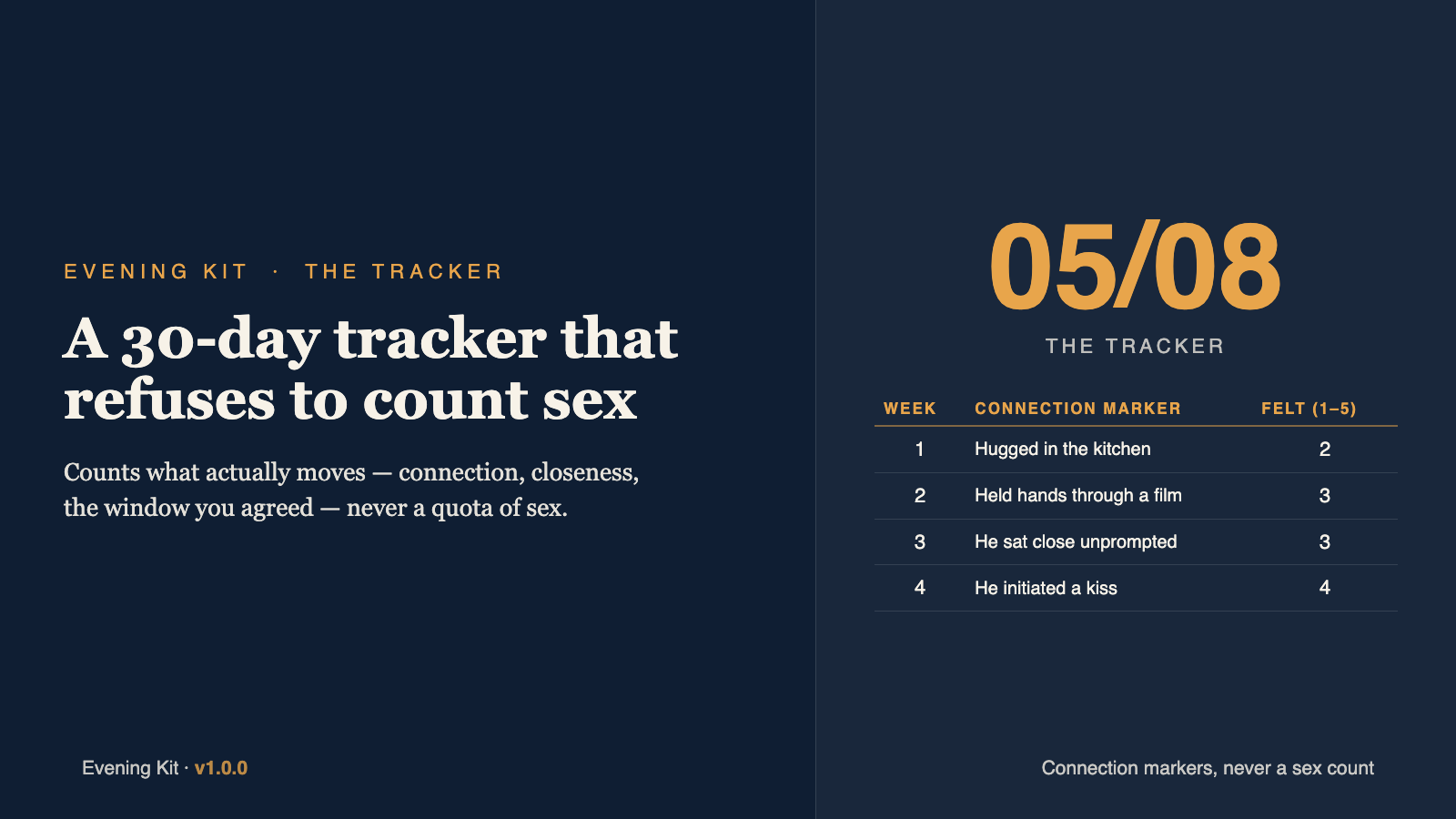
- Day 1 of a 30-day tracker that counts connection, never a quota of sex.
What the research shows, and what it doesn't
TL;DR
- Self-esteem and sexual satisfaction move together in longitudinal data; frequency itself showed no equivalent link.
- Sexual shame is linked to worse sexual functioning across arousal, desire, orgasm and pain, often in both directions.
- The pursue-withdraw loop is named by name, and interrupting it does not require a conversation to start.
- Feeling responded to, not disclosing more, is what tracked with satisfaction in one study of 263 couples.
- Prevalence is real and contested at the edges; every number here carries its own definition.
- Name what the data actually links. The 12-wave German study above is the clearest evidence in this corpus: self-esteem and sexual satisfaction move together over time. It does not say that fewer acts of sex directly cause lower self-worth; it says the two are entangled with each other in a way the raw count of times is not. Write-as discipline matters here: "associated with," never "causes."
- Understand shame's role, and its limit. One review reports that sexual shame negatively affects women's sexual functioning, arousal, desire, orgasm and pain, often reciprocally, with sociocultural messages, body and genital self-image, and sexual self-schemas among the contributors it names. Sexual trauma sits inside that same factor list. Where trauma is present, the honest next step is a licensed therapist, not a kit or a page; de-shaming education stays inside what this page can responsibly offer.
- Name the loop. The Gottman Institute's own explainer puts the mechanism in one sentence: "the behavior of one partner provokes and maintains the behavior of the other." Naming it is the article's whole contribution; it stops short of what either side does differently next, which is the gap a structured protocol exists to fill.
- Know what helps, and what backfires. Across three studies of 786 people, perceiving a partner's sexual autonomy support, not pressure, was linked to greater need fulfilment and to higher satisfaction for both partners, over and above general support and responsiveness. Separately, in a study of 263 couples where one partner reported low sexual interest, the higher-desire partner's own satisfaction and distress tracked with feeling responded to by the other, not with how much either one talked about it. Disclosure volume showed no equivalent link.
- Check prevalence honestly, without merging the numbers. About one in five long-term couples are in a sexless marriage, the Gottman Institute writes, citing Laumann et al. 1992, under 10 times a year. A separate 2025 meta-analysis of reproductive-aged women found sexual desire disorder ranging 8.0 to 91.0 percent across 16 studies, and pooled female sexual dysfunction at 47.81 percent (95 percent CI 39.19 to 56.43). Both are real; neither collapses into one tidy figure, because the definitions underneath them differ that much.
- Know the stress link cuts both ways. In a 14-day momentary study of 59 partnered young adults aged 18 to 30, higher subjective stress on a given day was associated with a lower likelihood of concurrent sexual desire, bidirectionally over time. The sample is young; the mechanism is not exotic. Your own stress is a lever you can act on tonight. It is not proof that anything is broken in the marriage.
The hard part: correlation is not a verdict on you
These studies show associations, not a courtroom verdict on any one marriage. "Reciprocal" means each factor predicted small later changes in the other in a large observational sample; nobody ran an experiment removing sex from otherwise-happy marriages for a decade to watch self-esteem, and no source this page relies on claims they did. The shame research names contributors that stretch far beyond any one relationship, sociocultural messaging and body image among them, and for some people that same factor list includes sexual trauma, which sits outside anything a kit or a page can treat; a licensed therapist is the right call for that. Nothing in this evidence promises that interrupting the pattern restores confidence on a fixed schedule, and no source this page relies on offers a guarantee that it will.
Questions people actually ask
What does a sexless marriage actually do to a woman, according to research?
The strongest longitudinal evidence links self-esteem to sexual satisfaction, not to frequency itself: each predicted small later changes in the other over 12 waves in more than 11,000 people. Separately, sexual shame is linked to worse sexual functioning across arousal, desire, orgasm and pain. Neither finding is a diagnosis of any one person.
Is it about missing sex, or something else?
The data points to something else: how satisfying and responded-to the connection feels tracks with self-esteem; the raw count of times per month did not show the same link in the same study. That is also why the kit's tracker counts connection and satisfaction markers, never acts.
How common is this, really?
About one in five long-term couples, per the Gottman Institute citing Laumann et al. 1992 (under 10 times a year). A 2025 meta-analysis of reproductive-aged women found desire-disorder prevalence ranging 8-91% across 16 studies, depending on definition. The numbers disagree because the definitions do, and they're never merged here into one figure.
Does pressuring him to initiate more help?
The evidence points the other way. Perceiving a partner's sexual autonomy support, not pressure, was linked to greater need fulfilment and satisfaction for both people, across three studies of 786 people. In a separate study of 263 couples, the higher-desire partner's own satisfaction and distress tracked with feeling responded to, not with how much either partner talked about it.
Is this a subscription?
No. One-time $29, printable tonight, no recurring charge.
Price, and what this doesn't cover
One-time purchase. No subscription, no recurring charge.
He Stopped Initiating: The 'Bring It Up Tonight' Kit. The self-esteem data explained honestly, the shame reframe, the loop named, the opener for tonight, and a tracker that counts connection, not acts. $29 once.
Sources (dated, checked 2026-09-11/17)
- Google autocomplete, "what sexless marriage does to a woman" among completions: suggestqueries.google.com (live 2026-09-11)
- Bing autocomplete, wave-2 run, "what can a sexless marriage do to a woman" among completions: api.bing.com (live 2026-09-11)
- Self-esteem and sexual satisfaction, 12-wave longitudinal study, N>11,000: Weber, Hangen, Neyer et al., Personality and Social Psychology Bulletin, doi.org (2024-09-18)
- Sexual shame and functioning review, arousal/desire/orgasm/pain, contributors and trauma named: Graziani & Chivers, Sexes (MDPI), doi.org (2024-12-03)
- Pursuer-distancer dynamic named, "the behavior of one partner provokes and maintains the behavior of the other": Terry Gaspard, LCSW, The Gottman Institute, gottman.com (published 2020-02-22, modified 2026-05-18)
- Sexual autonomy support and need fulfilment, three studies, N=786: Shoikhedbrod, Harasymchuk, Impett & Muise, Personality and Social Psychology Bulletin, doi.org (2024-09-30)
- Partner responsiveness vs. disclosure volume, 263 couples: Perrier Léonard, Rosen, Bigras, Massé-Pfister & Bergeron, The Journal of Sexual Medicine, doi.org (2025-05-28)
- Prevalence citing Laumann et al. 1992 (under 10 times/year, about one in five long-term couples): The Gottman Institute, gottman.com (published 2025-10-16, modified 2026-04-21)
- Pooled female sexual dysfunction prevalence 47.81% (95% CI 39.19-56.43%), desire disorder 8.0-91.0% across 16 studies: Heshmatnia et al., BMC Women's Health, doi.org (2025-09-29)
- Daily stress and concurrent desire, 14-day momentary study, 59 partnered young adults (18-30): Mües et al., Annals of Behavioral Medicine, doi.org (2025-01)
- Buyer voices, Reddit via Wayback, reported only: "sapped my confidence, lowered my self esteem" reddit.com/r/DeadBedrooms (2024-12-01); "32HLF sitting here crying" reddit.com/r/DeadBedrooms (2024-12-05)
- Rival audiobook's own marketing copy, "left feeling rejected, unattractive, frustrated, and confused": Audible catalog record, api.audible.com (live 2026-09-11)